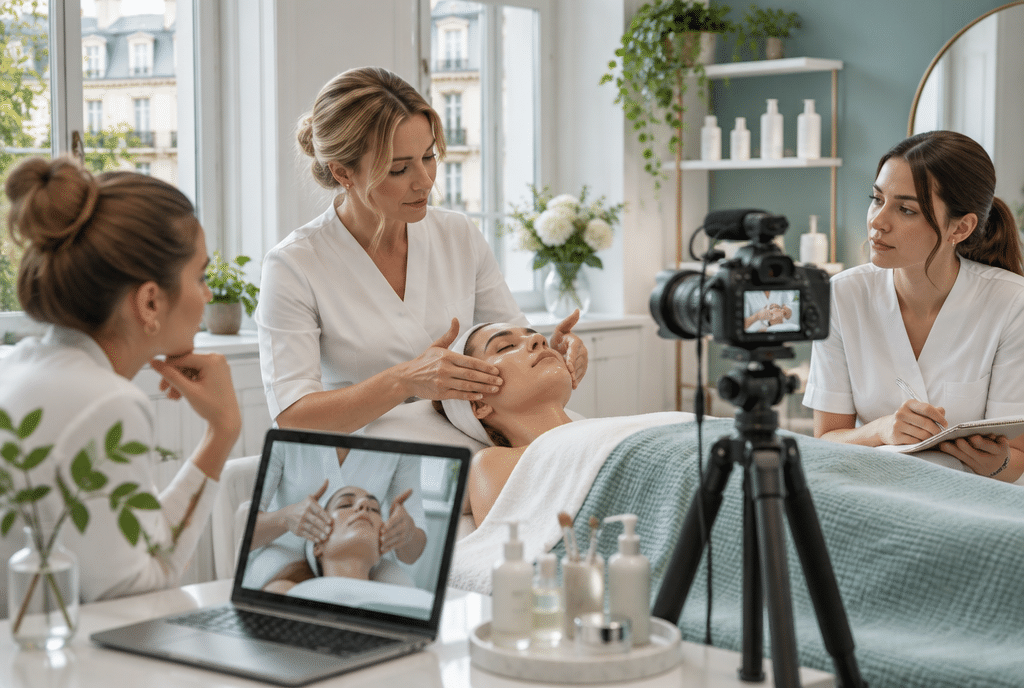

Retinol or retinal: you hear this question more and more often, because clients read ingredient lists and compare a high-street serum with what you recommend in the salon. Both molecules belong to the vitamin A family, but they stand on different rungs of the conversion to the active form, and that translates into strength of action, tolerance and the way they are introduced. Below you will find what you need in order to choose a retinoid deliberately and fit it safely around treatments.
The conversion pathway: from retinyl esters to retinoic acid
Retinoic acid is what acts on the nuclear receptors in skin cells. Cosmetic retinoids are its precursors, which the skin has to convert by itself. To know how to choose a retinoid, start with this pathway: retinyl esters, for example retinyl palmitate, are hydrolysed to retinol, retinol is oxidised to retinal (retinaldehyde), and retinal to retinoic acid. Each stage is an enzymatic reaction of limited efficiency. Retinal is one step away from the active form, retinol two, esters three. That number of steps organises the choice between retinol and retinal and explains why esters act most weakly.
Studies of the metabolism of retinal applied to the skin showed that keratinocytes convert it into retinoic acid, but a large part goes into the storage pool of retinyl esters. The skin thus receives a reservoir from which retinoic acid is formed gradually and in small amounts (Sorg et al., Dermatology). A review by the Geneva team describes retinal, retinol and esters as precursors with controlled conversion, which justifies their presence in cosmetics (Dermatologic Therapy, 2006).
Every step separating an ingredient from retinoic acid lowers the strength of action and raises tolerance. Knowing how to choose a retinoid comes down to choosing that distance.
Retinol or retinal: strength of action and tolerance
Retinoic acid acts most strongly and irritates most. In a study comparing the tolerance of the three forms, retinol and retinal caused low irritation and retinoic acid clearly higher. In a long-term observation of 355 people, erythema in the first four weeks appeared in 44% of those using retinoic acid, while with retinal signs of irritation occurred significantly less often (Fluhr et al., 1999). Retinol, although weaker, also produces measurable changes: after four weeks of use it increased epidermal thickness and the expression of collagen type I and III genes, to a lesser degree than retinoic acid (Kong et al., 2016).
Retinal also has a property the other two forms lack. In the study by Pechère et al., of retinol, retinal and retinoic acid only retinal inhibited in vitro the growth of Gram-positive bacteria, including Cutibacterium acnes and Staphylococcus aureus. In 22 volunteers applying 0.05% retinal to the forehead for two weeks the count of C. acnes fell significantly, and the authors found no resistant strains. They attributed the effect to the aldehyde group in the side chain (Dermatology, 2002). This was a study on healthy skin, so when choosing between retinol and retinal treat it as an argument for retinal with skin prone to blackheads and breakouts, without promises of treating acne.
Limits on vitamin A in cosmetics in the EU
Commission Regulation (EU) 2024/996 added Retinol, Retinyl Acetate and Retinyl Palmitate to Annex III of Regulation 1223/2009. The maximum concentration is 0.05% retinol equivalent (RE) in body lotions and 0.3% RE in other leave-on and rinse-off products, which includes face serums and creams and hand creams. The label must carry the warning: “Contains Vitamin A. Consider your daily intake before use”. From 1 November 2025 products that do not meet these conditions may not be placed on the market, and from 1 May 2027 they may not be made available on the market, which also covers existing stock (text of the regulation in EUR-Lex).
The limits follow from the opinion of the Scientific Committee on Consumer Safety: vitamin A from cosmetics adds to that taken in with diet and supplements. Retinal does not appear in this entry of the annex. Retinoic acid (tretinoin), in turn, is on the list of substances prohibited in cosmetics and in Poland is found in prescription medicines. Suggest a visit to a dermatologist to a client who expects the effect of tretinoin. If you run retail sales in the beauty salon, check whether the retinol products on your shelves already carry the new labelling.
How to choose a retinoid for the client’s skin
Before you decide how to choose a retinoid, ask about skincare to date, medication, reactions to acids and treatment plans for the coming weeks. The answer to the retinol-or-retinal question follows from the consultation more often than from skin type alone.
- Sensitive skin and beginners: retinol at a low concentration or retinyl esters. The start is gentlest and results appear more slowly.
- Photoageing with good tolerance: retinal or a higher concentration of retinol within the limit, after a period of adaptation on a weaker form.
- A tendency to acne lesions: retinal, because of the antibacterial action described, as part of the plan described in the article on care for acne-prone skin in the salon. Refer severe inflammatory acne to a dermatologist.
- A damaged barrier, a flare-up of atopic dermatitis or rosacea: you postpone the retinoid until the skin has calmed.
- Pregnancy, planning pregnancy, breastfeeding: you stop the retinoid, and the client agrees further skincare with her treating doctor.
Oral retinoids have documented teratogenic effects. A 2015 meta-analysis covering 654 women exposed to topical retinoids in the first trimester showed no significant increase in the rate of major congenital malformations, but the authors noted that the statistical power is too low to justify the use of retinoids in pregnancy (British Journal of Dermatology). This result reassures women exposed accidentally, and the decision on continued use belongs to the doctor.
Introduction, acids, vitamin C and SPF
The gradual method works regardless of whether the client has chosen retinol or retinal. The client starts with two applications a week, in the evening, in a pea-sized amount for the whole face, and increases the frequency only once the skin has reacted calmly for several weeks. With dryness, applying the retinoid between two layers of cream, or a shorter contact time before washing off, helps.
- AHA and BHA acids: separate them from the retinoid onto different evenings, because the exfoliation adds up.
- Vitamin C: in the morning, the retinoid in the evening.
- Peptides and niacinamide: these combine with a retinoid more calmly. We write about pairing retinoids with copper peptides in the article on GHK-Cu in cosmetics.
- Sun protection: retinol and retinal break down under light, which is why they are used in the evening. A high-SPF cream every morning, because exfoliated and irritated skin reacts with erythema more easily.
Retinoids and salon treatments
A retinoid speeds up exfoliation and can temporarily weaken the barrier, so the client stops it before chemical peels in the salon, microdermabrasion and waxing. The length of the break is set by the peel manufacturer’s protocol, and the deeper the treatment, the longer the break. Add a question about retinoids to the consultation card and ask it before every visit, including about medication: with oral isotretinoin, treatments that disrupt the epidermis require the consent of the treating doctor.
After a treatment the retinoid returns only once erythema and flaking have subsided. Agree that date with the client as she leaves, record it on the card and at the next visit assess how to choose a retinoid for the next stage of care.

How to choose a retinoid by ingredients and packaging
How do you choose a retinoid with nothing but the label in front of you? Start with the INCI names. Retinol appears as Retinol, retinal as Retinal, esters as Retinyl Palmitate, Retinyl Acetate or Retinyl Propionate. Hydroxypinacolone Retinoate is an ester of retinoic acid described by manufacturers as a mild form, with fewer comparative studies than retinol. Bakuchiol is sometimes advertised as a retinol substitute, but chemically it is not a retinoid and you do not count it in this family.
Position in the ingredient list says less about concentration than it suggests. Regulation 1223/2009 allows ingredients present at below 1% to be listed in any order, and retinoids work precisely in that range. A retinoid at the end of the list can therefore have a higher concentration than the plant extract before it. Reliable information comes from the manufacturer’s declaration: the percentage of retinol or retinal and, for retinol, the conversion to RE.
- Packaging: airless, an aluminium tube or an opaque bottle with a pump. Retinol and retinal oxidise in contact with oxygen and break down in light, so a jar opened with the fingers and clear glass shorten their shelf life.
- Encapsulation: lipid or polymer shells release the retinoid gradually, which softens the start for reactive skin.
- Company in the formula: antioxidants such as tocopherol protect the retinoid from oxidation, and ceramides, glycerine and panthenol limit dryness.
- Period after opening: the PAO symbol with a number of months on the packaging. A retinoid product kept in a warm bathroom loses activity faster.
How do you choose a retinoid within one product line? Arrange a path from the weakest form to the strongest: retinyl esters, retinol at a low concentration, retinol closer to the 0.3% RE limit, and retinal at the end. In cosmetics with retinal you will most often meet concentrations of the order of 0.05 to 0.1%, lower than for retinol, which follows from its greater activity. You therefore compare numbers from two different forms with caution: 0.1% retinal acts more strongly than 0.1% retinol.
A change in the colour of a serum to dark yellow or orange and a rancid smell are a sign of breakdown. Ask the client to bring the product she is using to the follow-up visit. When you compare retinol and retinal from the same line, you are comparing formulas with a similar base, and the difference in the skin’s reaction then comes mainly from the form of vitamin A.
The same rules apply to stock in the salon. Keep retinoid products away from the window and the radiator, and when accepting a delivery check the expiry date and labelling in line with the new limits. When a client asks how to choose a retinoid from the products on your shelf, show her the packaging and explain what each piece of information on the label means. Such a conversation takes a few minutes and teaches her to assess products bought outside the salon for herself.
Retinol or retinal: an introduction plan week by week
The general rule of gradual progression is described above. Give the client a specific schedule, with dates entered on the card. The scheme below concerns skin with no contraindications and stays the same regardless of whether you have chosen retinol or retinal. With retinal the pace of moving to the next stages can be slower, because the skin reacts with dryness sooner.
| Week | Frequency | What you watch for |
|---|---|---|
| 1 and 2 | 2 evenings a week | stinging lasting longer than a few minutes after application |
| 3 and 4 | 3 evenings a week | flaking around the nose and the corners of the mouth |
| 5 to 8 | every other evening | a feeling of tightness in the morning, rough cheeks |
| from 9 | every day or every other evening, according to tolerance | stable skin for the following 2 weeks |
The first weeks are the retinisation period: dryness, fine flaking and slight erythema are among the expected reactions and usually ease as the skin adapts. Warn the client about this before she starts, because without that information many people stop the product after a week. Stinging that lasts for hours, swelling, oozing or blisters mean a break and contact with you, and with a doctor if symptoms are severe.
- Application: on dry skin, a few minutes after washing, a pea-sized amount for the whole face.
- Sensitive zones: protect the sides of the nose, the corners of the mouth and the eyelids with a thin layer of protective cream before applying the retinoid.
- Neck and décolleté: the skin there is thinner, so you add them only after the face has adapted, and less often.
- One new product at a time: during the introduction period the client does not add other active ingredients, so you know what caused a reaction.
The evening order is simple: gentle cleansing, drying the skin, the retinoid and, a few minutes later, cream. The client can apply a niacinamide or peptide serum under the cream. The choice between retinol and retinal affects the pace, while the order stays the same: with retinal you stay longer at the stage of two and three evenings a week. Hand over the schedule in writing, with space for notes on reactions, and ask for a photograph of the skin if erythema appears between visits.
Phototype, season and skin reactivity
How do you choose a retinoid for darker skin? In phototypes IV, V and VI every irritation carries a greater risk of post-inflammatory hyperpigmentation. With these clients the slower pace from the table is mandatory, and you introduce retinal only after a calm period on retinol. In phototypes I and II the skin more often responds with erythema and stinging, so you watch the cheeks and the area around the nose, where vessels are most visible.
Retinol or retinal for dark skin with hyperpigmentation? Both forms even out skin tone, but with this client the outcome is decided by the absence of irritation, so retinol with a slow schedule and consistent photoprotection proves itself more often.
The most convenient start falls in autumn and winter, when the UV index in Poland is low and clients spend less time in the sun. In the heating season, however, the air in homes can be very dry, so at this time a ceramide cream applied over the retinoid matters more. In spring and summer the retinoid stays in evening care, and the daily SPF needs reapplying during long periods outdoors.
- A holiday in a warm country: you advise against starting two or three weeks before departure, because the peak of retinisation would fall on the beach.
- Skiing and high mountains: strong UV reflected from snow and wind add to dryness, so for the duration of the trip the client can reduce the frequency of application.
- Reactive skin after a treatment: you plan the return to the retinoid from the lowest frequency in the table, regardless of whether it was retinol or retinal and how often the client used it before.
Mature skin, especially around the menopause, is usually thinner and drier, and its barrier regenerates more slowly. How do you choose a retinoid for such a client? Choose a cream formula with emollients, start with retinol at a low concentration and extend each stage of the schedule by a week or two. You consider retinal after several months of calm skin, when the client expects a clearer effect on photoageing.
A client with a history of rosacea or atopic dermatitis in remission needs caution even after the skin has calmed. With her, the choice between retinol and retinal usually comes down in favour of low-concentration retinol, and you consult any change of form with the treating dermatologist.
How to measure the result and set the client’s expectations
A retinoid works slowly, so without documentation the client judges the result by the mirror and her mood. Take photographs before the start and every 4 weeks, in the same place in the salon, in the same lighting, from the same distance, without make-up. Three shots: front-on and two profiles at a 45-degree angle. If you have a skin analyser, record the texture and pigmentation parameters on the card, and repeat the measurement in the same conditions.
Clinical studies of retinoids in photoageing usually last 12 to 24 weeks, and that is the horizon in which to discuss anti-ageing results with the client. The first changes clients notice usually concern smoothness and evenness of skin tone. Fine lines require months of regular use. Explain in advance that a retinoid in a cosmetic acts more gently than tretinoin prescribed by a dermatologist, and that static wrinkles and loss of firmness require a treatment plan.
- Client card: product name, form and concentration, start date, current frequency, reactions and the dates of breaks before treatments.
- Follow-up visits: after 4, 8 and 12 weeks. At each one you assess tolerance and decide how to choose a retinoid for the next stage.
- Change of form: you plan the move from retinol to retinal after at least 8 weeks of calm skin at the highest tolerated frequency.
Conduct the conversation before the start according to a fixed list: which product, how many times a week, which reactions are expected, when to stop and whom to contact. Retinol or retinal in home care is a decision the client carries out by herself over many weeks, which is why verbal recommendations given in the salon are easily forgotten. Written instructions with the dates of follow-up visits reduce phone calls with questions and cases of stopping the product because of expected flaking.
When a client asks after three months how to choose a retinoid for further care, you have the photographs and card records in front of you. On that basis you decide: she stays with the current product, increases the frequency or moves to a form closer to retinoic acid. The client then sees where the recommendation comes from and is more willing to stay with skincare bought in the salon.
The most common questions about retinol and retinal
Will retinal always work better than retinol?
Retinal acts faster because it stands closer to retinoic acid. With sensitive skin or skin entirely new to retinoids, it is more sensible to start with retinol and move to retinal after a period of adaptation.
Which concentration of retinol should I start with?
With the lowest in the given product line and with infrequent applications. The upper limit in face products is 0.3% RE, so higher declarations on the label are a signal to check the product more closely.
Can a pregnant client use retinol?
In the salon, adopt the precautionary principle: the retinoid is stopped for the duration of pregnancy and breastfeeding, and skincare decisions are made with the treating doctor.
After how many weeks are the results of retinol or retinal visible?
Clients usually notice smoother skin and a more even tone after a few weeks, and you should plan the assessment of anti-ageing action after 12 weeks of regular use. Regardless of whether the client chose retinol or retinal, compare photographs taken in the same conditions.
What should be done when the skin flakes in the first month?
Fine flaking during the retinisation period is typical. The client goes back to the previous frequency in the schedule, applies a ceramide cream under and over the retinoid and, if stinging lasts for hours, takes a break and comes in for a check.
For the salon in brief: retinal is one step closer to retinoic acid than retinol, acts faster and shows antibacterial activity. Retinol is gentler to start with. In the EU, retinol and its esters have a limit of 0.3% RE in leave-on products, including those for the face, and 0.05% RE in body lotions, and retinoic acid is prohibited in cosmetics. Before you decide how to choose a retinoid, carry out a consultation. Introduce it gradually, separate it from acids and vitamin C, stop it before exfoliating treatments and, in pregnancy, refer the client to a doctor.
Would you like to work out how to choose a retinoid for your clients’ home care and fit it around the treatment schedule? Book a free consultation and see the professional cosmetics wholesale offer.