
Needle-free mesotherapy is one of those treatments that sell themselves, because they promise the effect of an injection without a needle. Part of that promise comes from studies, part from sales materials, and the difference between them translates directly into how you talk to a client and where you set the limit of expectations.
Needle-free mesotherapy is two different mechanisms
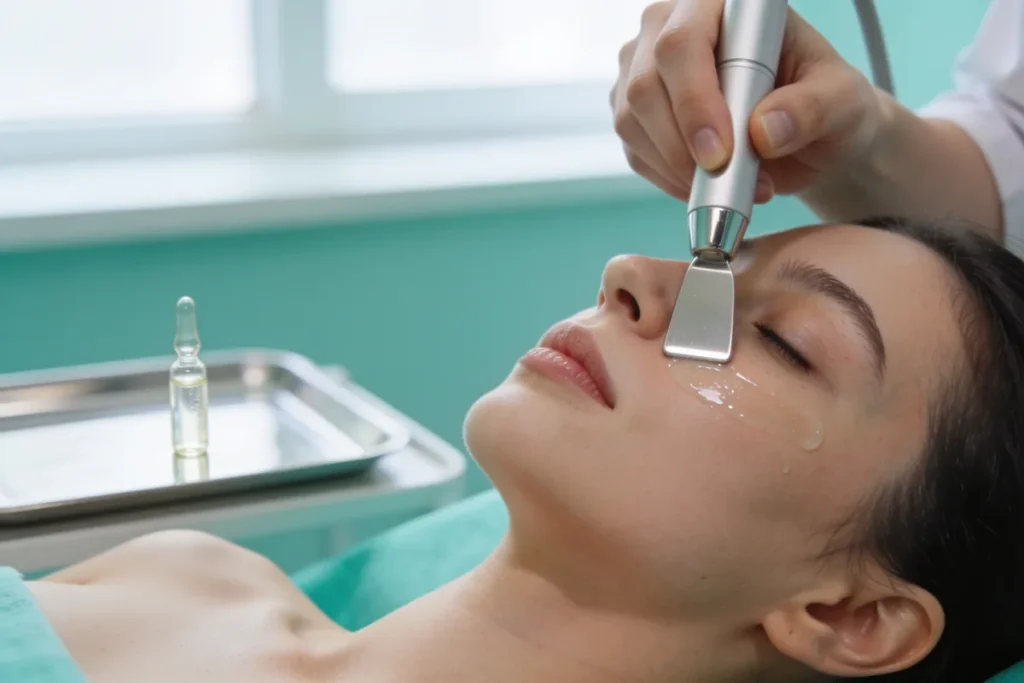
Needle-free mesotherapy usually covers two different technologies. Sonophoresis uses ultrasound, and the main mechanism is taken to be cavitation, that is the formation and collapse of microbubbles, which temporarily loosen the ordered lipid structure of the stratum corneum. Thermal and mechanical effects are of secondary importance. Electroporation is based on short electrical pulses that temporarily disrupt the continuity of the lipid bilayers, and transport takes place mainly through increased diffusion and electrophoretic phenomena.
Both technologies on which needle-free mesotherapy rests act on the same obstacle, the stratum corneum. Both also fail to carry substances in a way that could be dosed precisely, which review authors identify as one of the main limitations.
Where the spectacular numbers come from
Marketing materials feature multiples of penetration in the order of hundreds or thousands. These numbers exist in the literature, but they come from laboratory and animal studies, run on model substances and at parameters that salon devices do not usually reach. A review devoted to low-frequency sonophoresis describes very large increases in penetration for hydrophilic compounds, while listing problems with dose calibration, irritation and the lack of data on the long-term safety of repeated treatments.
To the question of how deep a substance reaches after a treatment in the salon there is no good answer today. In the databases searched, no controlled human study could be found that measured the concentration or depth of a substance after cosmetic sonophoresis or needle-free mesotherapy. Statements about reaching the deeper layers of the skin remain at the level of claims, with no support in measurements.
The larger the molecule, the smaller the chance that it will pass through an intact stratum corneum. Physics decides this, not the power of the device.
The five hundred dalton rule and hyaluronic acid
In dermatology there is a practical heuristic which says that compounds with a weight above about five hundred daltons do not penetrate an intact stratum corneum. It is not a law of physics, but it conveys the scale of the problem well. Hyaluronic acid is a good example. In a spectroscopic study on human skin, low molecular weight fractions penetrated the stratum corneum, and high molecular weight fractions stayed on the surface.
The conclusion for the salon is practical. A product with collagen or high molecular weight hyaluronic acid will act mainly as an occlusive and hydrating layer on the surface, which in itself gives a visible smoothing effect. It is not worth promising, however, that these molecules get deep into the skin. We write more about what science means by improving skin condition in the article on skin quality.
Who needle-free mesotherapy makes sense for
- Dehydrated and dull skin: as part of a series improving the comfort and appearance of the surface.
- Acne-prone skin in a stable phase: the method is sometimes included in sets of treatments with which an improvement in patients’ quality of life was observed. The contribution of needle-free mesotherapy alone cannot be isolated from these studies.
- A complement to the protocol: as a gentle close to the visit after exfoliation, when the skin does not tolerate more intensive stimuli.
- Clients who do not want a needle: with a clear explanation that needle-free mesotherapy has a different mechanism and a different scale of action from the injectable kind.
Contraindications come mainly from the device manufacturer’s instructions, and that is where to look for them. In practice caution is exercised with pacemakers and electronic implants, metal implants in the treatment field, pregnancy, active infections, cancerous lesions and damaged skin.
How to talk about needle-free mesotherapy and how to price it
Needle-free mesotherapy sells best with a precise description. The treatment is pleasant, painless and does not take the client out of her daily life, and immediately afterwards the skin looks better hydrated and more rested, mainly thanks to the layer of product left on the surface. This effect is short-lived, and that is how it should be described. That is exactly why it works very well as a pre-event treatment and as a way of introducing a new client to the salon. It works poorly as a stand-alone answer to laxity or deep wrinkles, because there are no data to justify that.
When pricing, count the cost of the product, workstation time and depreciation of the device, and then place the treatment in a series, because a single visit rarely meets expectations. We describe the rules for building series and packages in the article on treatment passes and packages, and the overview of professional cosmetics in Este Sklep makes choosing products easier.
What to ask the device manufacturer
Because effectiveness depends on parameters and not on the name of the technology, it is worth knowing what to look for in the specification. With sonophoresis the working frequency matters, because the literature clearly separates low-frequency ultrasound, in the range of tens of kilohertz, from high-frequency, counted in megahertz. These two ranges act in different places and on a different scale. With electroporation what matters is the voltage, length and frequency of the pulses and whether the device lets you adjust them.
The second group of questions concerns products. Does the device manufacturer specify particular formulations or allow any. What is the molecular weight of the active ingredients in the recommended line. Is the product intended for work with the given device, or is it an ordinary serum. The mechanisms of transdermal transport are described, among others, in the review devoted to low-frequency sonophoresis, and the dependence of penetration on molecule size in the classic paper on the five hundred dalton rule.
The most common questions about needle-free mesotherapy
Does needle-free mesotherapy replace the injectable kind?
No. It is a treatment with a different mechanism and a different scale of action. Injectable mesotherapy delivers the substance below the stratum corneum, because it breaks the continuity of the epidermis with a needle.
How many needle-free mesotherapy treatments are needed to see a result?
The hydrating effect can be visible from the first visit, but it is short-lived. Cosmetology studies usually use series of five to a dozen or more treatments at weekly intervals.
Can this treatment be combined with others?
Yes, it is most often combined with cleansing and exfoliation. With treatments that disrupt the barrier, however, remember that introducing products into damaged skin increases the risk of adverse reactions.
For the salon in brief: needle-free mesotherapy works well as an introductory treatment that improves the appearance of the skin for a few days. The mechanisms have been described in the laboratory, but clinical data on the depth of transport are lacking. Choose products with a low molecular weight and do not promise results reserved for injections.
Would you like to choose products for needle-free mesotherapy and plan a series by indication? Book a free consultation and see professional cosmetics in Este Sklep.