
Cavitation peeling is, in many salons, the first treatment a new client gets to know and one of the most frequently performed during the day. It is quick, painless and cheap to deliver. The literature on it is, however, far more modest than the treatment’s popularity would suggest, and it is good to know that before talking to a client.
What the treatment involves
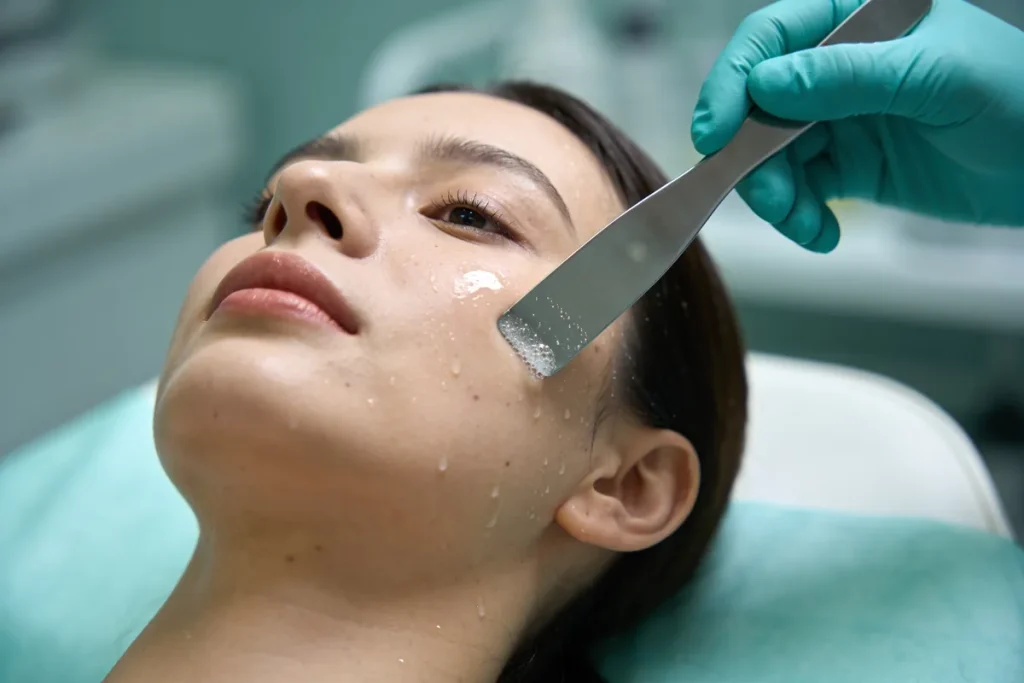
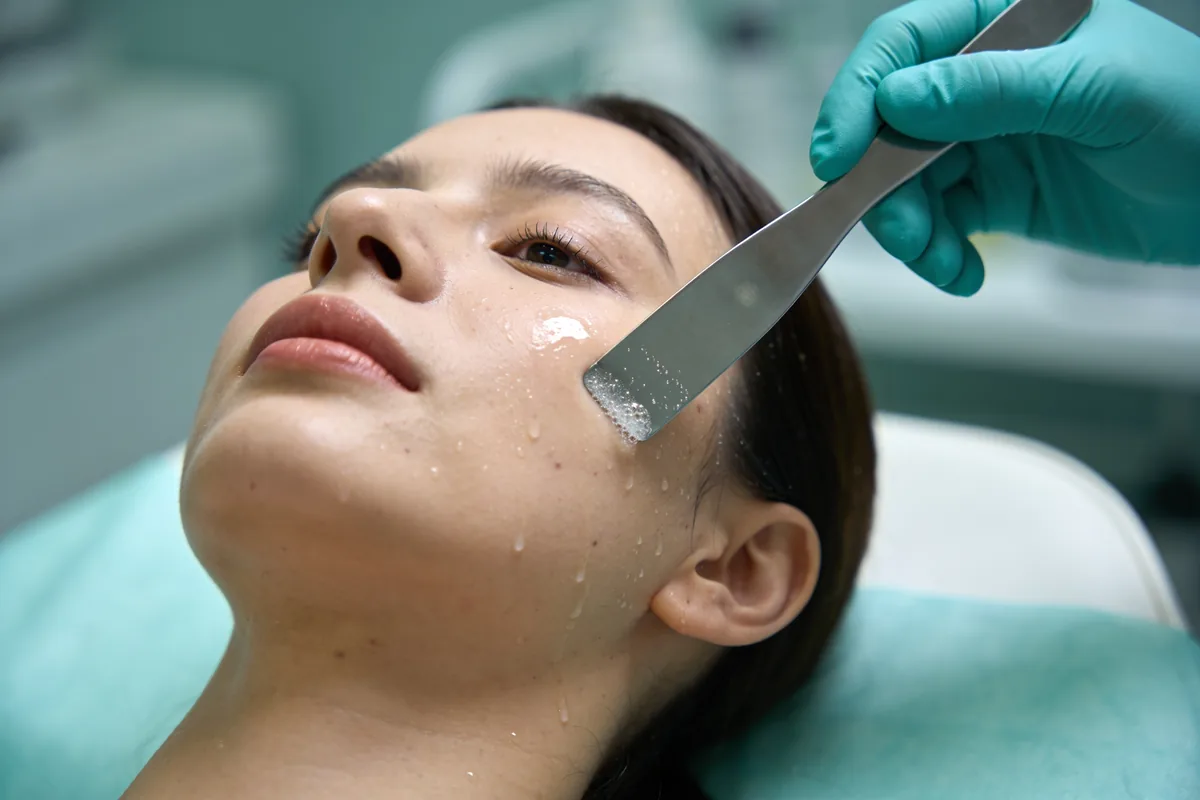
Cavitation peeling is performed with a metal spatula vibrating at ultrasonic frequency, moved over moistened skin. The mechanism described combines exfoliation of dead epidermal cells with emulsifying sebum and softening the contents of the sebaceous gland openings, which makes later cleansing easier. The skin must be wet, because it is in the thin film of water that the phenomenon of cavitation is supposed to occur.
A distinction is needed here. The phenomenon of cavitation with low-frequency ultrasound is well described in the literature on transdermal transport. In the databases searched, however, no peer-reviewed publication could be found describing the working mechanism of the devices sold as cavitation peels. The explanations given in salons come mostly from manufacturers and have not been independently confirmed.
The treatment works on the surface of the epidermis, and that is where its reach ends. The trouble starts with descriptions suggesting an anti-ageing effect.
What the studies say
The evidence is modest. The only paper found that relates directly to this treatment covered nine women with seborrhoeic skin and blackheads who had six treatments at intervals of ten to fourteen days. A significant fall in sebum secretion was observed in all the facial areas studied, along with a reduction in blackheads in photographic and questionnaire assessment. The improvement in hydration was significant only on the chin.
Two caveats have to be added. In this study cavitation peeling was combined with crystal microdermabrasion, so the contribution of cavitation alone cannot be isolated. The sample was very small and there was no control group. The honest wording is therefore: in a small pilot study a fall in sebum secretion was observed, and not: studies confirm the effectiveness of the treatment.
Cavitation peeling also appears in papers assessing whole sets of cosmetology treatments in people with acne, where an improvement in patients’ quality of life was recorded. There, too, the method was not assessed separately. Such results are valuable for the salon, because they show that a well-run series really changes how a client feels, but they do not allow the credit to be given to one technology. You will find a description of the study on combining microdermabrasion and cavitation peeling in the publication record in the PubMed database.
Where cavitation peeling works best
- Seborrhoeic, oily and combination skin with blackheads: as a preparatory stage before manual cleansing.
- A first visit: low risk, no downtime and immediately visible smoothness are a good start to the relationship.
- Part of a combined protocol: before applying products or before a hydrating treatment, when you want to remove the layer of dead epidermis.
- Skin that does not tolerate chemical stimuli: as a gentler alternative to acids during a calming period.
The treatment is poorly suited where the problem is scars, deep wrinkles or laxity. Its action concerns the surface of the epidermis, and that is how it should be described.
Contraindications and safety
The available scientific sources contain no systematic list of contraindications for this treatment, so the basic document is the device manufacturer’s instructions. In practice caution is exercised with active skin inflammation, purulent lesions, a damaged barrier, recent treatments using acids, the use of oral retinoids and around lesions of an unclear nature. We describe how to recognise the moment when a medical consultation is needed instead of a treatment in the article on skin diagnostics in the salon.
Place in the offer and pricing
Cavitation peeling is rarely a good product sold separately. Its strength lies in the fact that it costs little time and material and noticeably raises the perception of the whole treatment. That is why it most often comes as part of a protocol combined with cleansing, sonophoresis or a hydrating treatment, and on the price list it appears as a component of a package more than as a low-priced item.
If you set it against other exfoliation methods, it is worth comparing the scope of action with oxybrasion, with diamond microdermabrasion and with chemical peels, because each of these methods works differently and burdens the skin differently. We describe how to build a series and pricing in the article on cosmetic treatment prices.
Technique matters more than the device
The difference between an effective cavitation peel and one for show usually lies in three details. The first is moistening the skin: a spatula moved over dry skin loses its purpose, because the phenomenon the treatment is based on occurs in a film of water. That is why the skin is moistened continuously and not once at the start. The second is the angle and pace of moving the tip. Too steep an angle causes unpleasant scratching and irritation, and moving too quickly gives no time for it to work. The third is the order: the treatment is performed after cleansing and softening the skin, not over residual make-up.
Keep an eye on the condition of the tip itself too. A chipped or deformed spatula transmits vibrations unevenly and irritates more often. It is a consumable part with a service life described by the manufacturer, and in practice it is sometimes used for years.
The most common questions about cavitation peeling
How often can this treatment be performed?
In the study that describes it, treatments were performed every ten to fourteen days. In salon practice similar intervals are used for oily skin, and less frequent ones for sensitive skin.
Does cavitation peeling remove blackheads?
Manufacturers describe it as a stage that makes their removal easier by softening the contents of the gland openings, and in salon practice that is exactly how it is used. By itself it replaces neither manual cleansing nor home care matched to seborrhoeic skin.
Is it a good anti-ageing treatment?
There are no data to justify that. The smoothing effect comes from exfoliating the surface of the epidermis and is short-lived.
For the salon in brief: cavitation peeling works on the surface of the epidermis, and its evidence base is limited to one small study, combined with microdermabrasion at that. The literature gives no list of contraindications, so the manufacturer’s instructions apply. Sell it as part of a protocol and a preparatory stage. Answer questions about skin ageing with other treatments.
Would you like to choose a device and build a protocol for seborrhoeic skin? Book a free consultation and see este:med devices in Este Sklep.