
Hyperpigmentation and melasma are among the problems where it is easiest to do harm with good intentions. Hyperpigmentation in the beauty salon also requires differentiation, because each type responds differently. An aggressive treatment on skin prone to an inflammatory response can deepen what it was meant to remove, and a promise of getting rid of melasma for good is a promise that cannot be kept. A good protocol therefore starts with identifying the type of hyperpigmentation and with a conversation about the time horizon.
Melasma follows its own rules
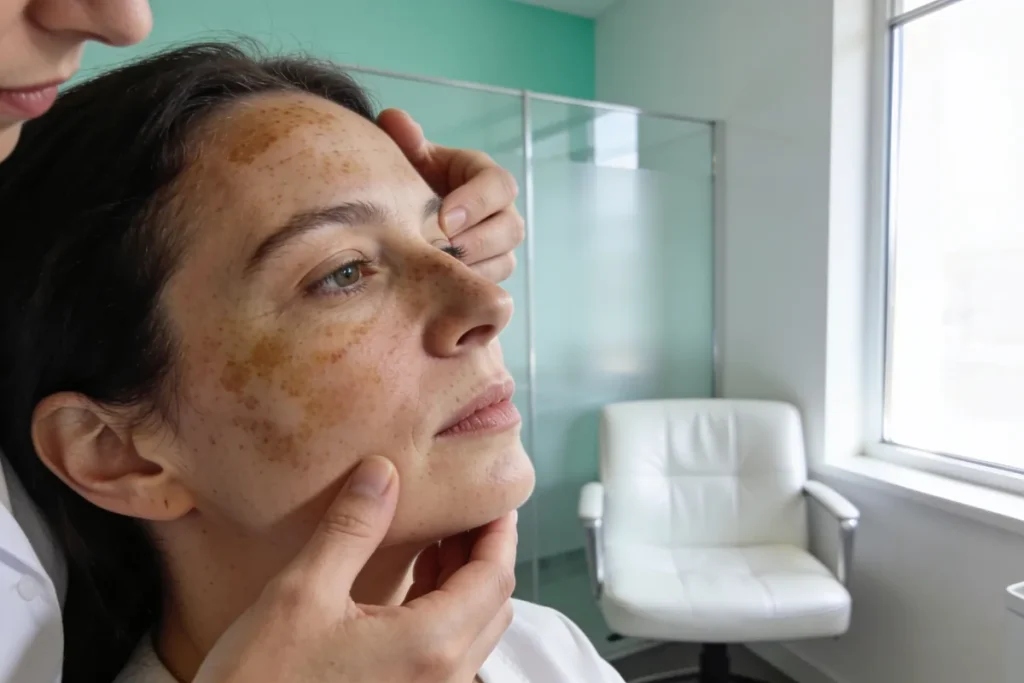
Melasma is a chronic, recurrent pigmentary disorder, occurring mainly in women and more often in higher phototypes. Current publications describe it as a phenomenon much broader than overactive melanocytes. They list changes in the epidermis and basement membrane, solar elastosis, the involvement of mast cells, a vascular component and ageing fibroblasts. The triggers are ultraviolet radiation, visible light and hormonal fluctuations.
A practical consequence follows from this description. Since the process involves several mechanisms, a single brightening treatment will not solve the problem, and stopping photoprotection will undo the results of the whole series. This conversation should take place at the first visit, before the client pays for a package.
With melasma the aim is control, not a cure. A salon that says so plainly builds trust faster than one that promises removal.
Photoprotection is part of the protocol
The strongest data in the whole subject concern sun protection. In a randomised study all participants used the same topical treatment, based on hydroquinone, a substance that is not permitted in cosmetics in the European Union. The sunscreen made the difference: the group using a product with iron oxides, which also protects against visible light, achieved a clearly better result on the melasma assessment scale than the group with a sunscreen acting only on ultraviolet. The practical conclusion therefore concerns the choice of sunscreen, not transferring the whole protocol to the salon.
For the salon this means something concrete: with hyperpigmentation you recommend a tinted sunscreen, teach reapplication and treat this as part of the protocol, not as an add-on sale. We describe how to weave home care into the visit in the article on retail sales in the salon.
Ingredients and the limits of cosmetics law
- Hydroquinone: banned in cosmetics in the European Union, with narrow exceptions that do not concern facial care. At therapeutic concentrations it remains a matter for the doctor.
- Arbutin and alpha-arbutin: permitted at limited concentrations, and the hydroquinone content of the product must not exceed unavoidable traces. Deoxyarbutin is banned.
- Kojic acid: permitted as a brightening agent in face and hand products at a limited concentration.
- Retinol and retinyl esters: subject to the limits that apply in cosmetics, unlike tretinoin, which is a medicine.
- Tranexamic acid: in topical form the data are promising, but the quality of studies can be low. Oral administration is a doctor’s decision, with its own contraindications.
- Vitamin C: improvement is described, but requires long use, and the optimal concentration has not been established.
It is good to know these limits not only because of the regulations, but also because some products available outside official channels contain prohibited substances. We describe how to read ingredients and choose lines for the salon in the article on professional cosmetics.
Post-inflammatory hyperpigmentation and treatment risk
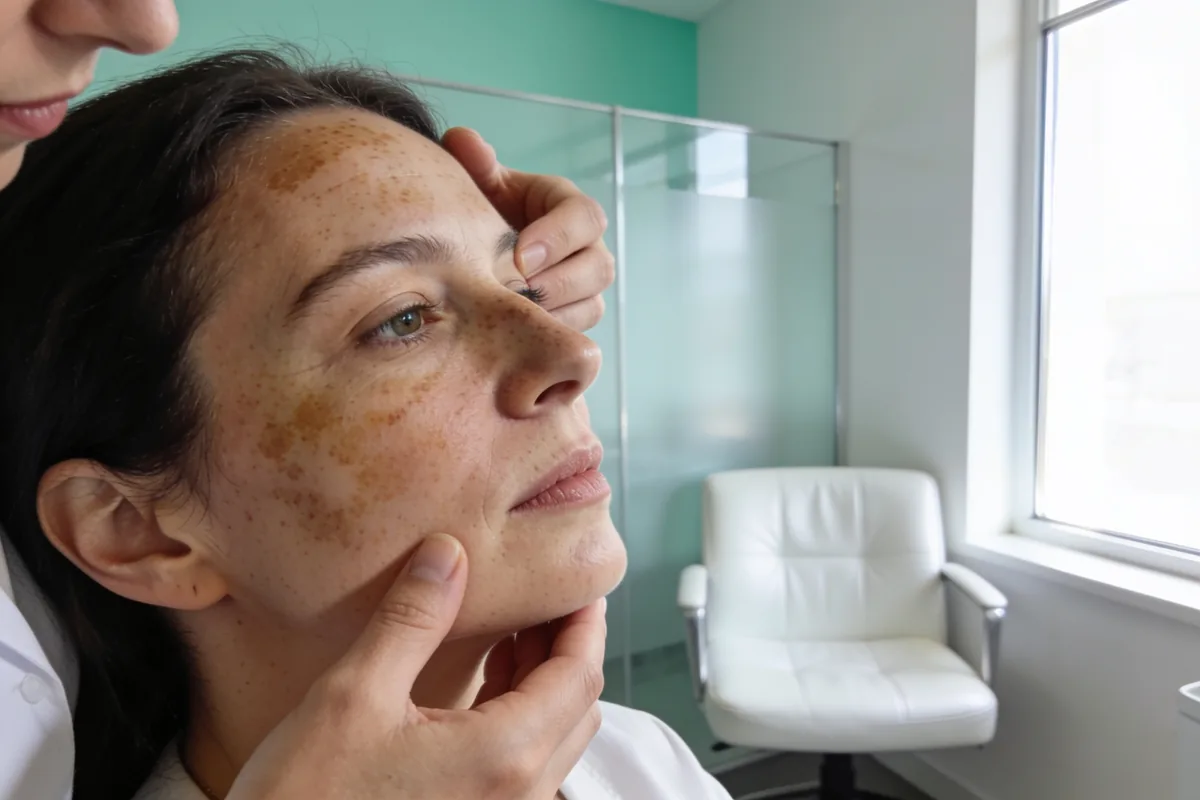
The second large group is post-inflammatory hyperpigmentation, arising after acne, a treatment or an injury. It is more frequent and more pronounced in higher phototypes, and in the course of acne in people with darker skin it is described in a considerable proportion of patients. Pigment located deeper lasts longer than epidermal pigment and responds less well to treatment. A systematic review covering several dozen studies on post-inflammatory hyperpigmentation in people with darker skin did not show solid efficacy for any single method, and some reports describe a worsening of hyperpigmentation after laser treatments.
Hence the rule of conduct: first settle the inflammation, then photoprotection, and brightening only at the end. For acne-prone skin we describe the protocol in the article on care for acne-prone skin, and the rules for choosing acids in the article on chemical peels.
How to build a protocol in the salon
A sensible path has four stages. The first is preparation: tinted photoprotection, gentle care, rebuilding the barrier, stopping irritants, for a minimum of two to four weeks. The second is gentle exfoliation matched to the phototype, at concentrations that will not provoke an inflammatory response. The third is maintenance, that is home work with ingredients permitted in cosmetics. The fourth is an assessment after three months, based on photographs taken in the same light and the same position.
With higher phototypes the rule of smaller steps applies. It is better to perform more gentle treatments than one intensive one after which the hyperpigmentation deepens. A full discussion of the evidence on treating melasma was published in a review in the American Journal of Clinical Dermatology.
The conversation about expectations
With hyperpigmentation most complaints come from an unestablished reference point. That is why it is worth working from the start with photographs taken in the same place, in the same light and without make-up, and recording the date of every change in skincare. After two months the client’s memory and yours will agree only if you both have the same material to compare.
It also helps to name the factors the salon has no influence over. Pregnancy, hormonal contraception, photosensitising medication, working by a window and holidays in the sun are variables stronger than most treatments. A client who understands this reads the absence of a spectacular result after three weeks differently and less often breaks off the plan halfway.
The most common questions about hyperpigmentation
Can melasma be removed permanently?
No. It is a chronic and recurrent disorder in which the aim is to control its severity and limit recurrences, mainly through consistent photoprotection.
Can sunscreen be dropped in winter?
Not with hyperpigmentation. Part of the process is driven by visible light, which also reaches the skin on cloudy days and through glass, which is why a tinted sunscreen is recommended all year round.
When should I refer a client to a dermatologist?
With hyperpigmentation that appears suddenly, is one-sided or changes over time, and also when the client is taking new medication or expects therapy with prescription medicines.
For the salon in brief: distinguish melasma from post-inflammatory hyperpigmentation, rely on photoprotection that also covers visible light and work in small steps, especially with higher phototypes. Promise control of severity, because permanent removal is not possible.
Would you like to set out a protocol for hyperpigmentation and choose products that comply with the regulations? Book a free consultation and see professional cosmetics in Este Sklep.