
LED light therapy has returned to salons in panel and mask versions, and with it promises ranging from acne to lifting. The literature is surprisingly specific on this: some indications have decent support in studies, others much weaker. The line between them runs exactly where the risk of a disappointed client begins.
How LED light therapy works
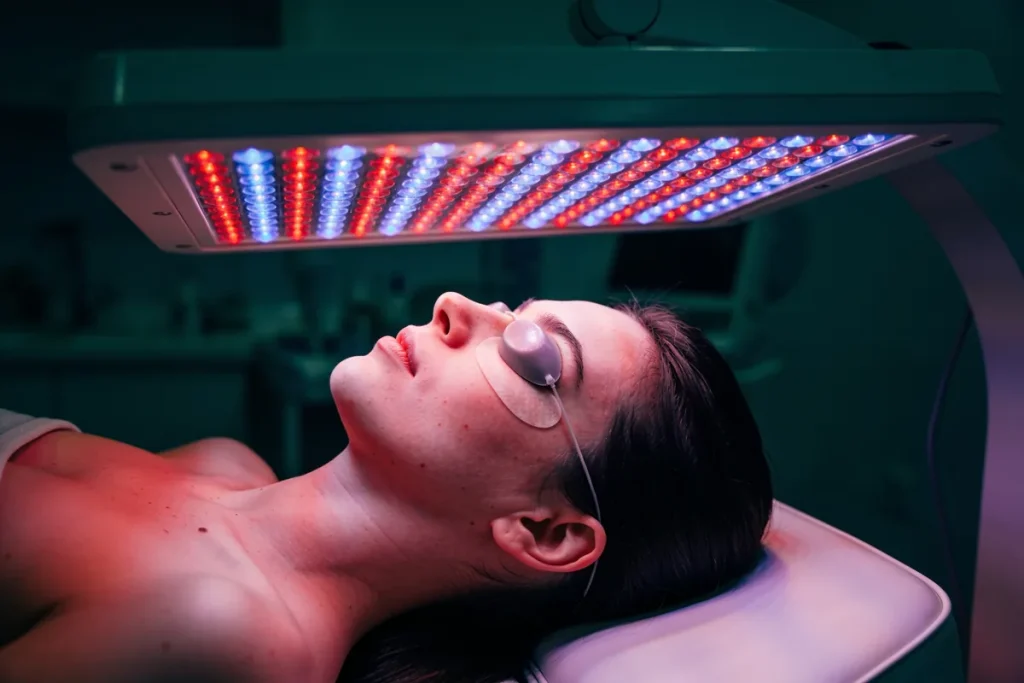
LED light therapy, called photobiomodulation in the literature, is based on the absorption of photons by natural chromophores in cells, above all by mitochondrial cytochrome c oxidase. Absorption triggers intracellular signalling pathways that are meant to translate into cell metabolism and repair processes. In acne there is a separate mechanism: blue light activates porphyrins produced by Cutibacterium acnes bacteria, and the reactive oxygen species that form act on those bacteria.
Review authors note, however, that the physics of the phenomenon and the radiometric parameters remain insufficiently described, which makes it hard to establish doses. This explains why study results differ so much: wavelength, power, exposure time and distance from the skin can be completely different from one publication to another.
With LED light there is no such thing as one treatment. There is wavelength, dose and time, and each combination of them is a separate intervention.
LED light therapy: where the evidence is decent
A systematic review of randomised studies published in 2018 covered thirty-one papers and assessed the strength of recommendations for individual indications. The highest rating in this comparison went to acne vulgaris, herpes simplex and shingles, and support for the healing of acute wounds, including after laser treatments. Base the description of the treatment in your offer on these.
You do need to know the limits of this rating, though. The studies were usually small, often with fewer than twenty people, rarely blinded, and the light parameters varied widely. A review of reviews on acne, published in the Cochrane Library in 2024, states that there is no high-certainty evidence for any of the methods analysed. A sensible wording for the client is therefore: LED light is a valuable supporting element, not a stand-alone treatment.
Where the evidence is weak
LED light therapy in skin rejuvenation performs much worse in the same review. Six randomised studies produced a lower rating, and in one of them red light improved neither elasticity nor hydration. A separate 2024 review assessing the effect of energy-based devices on sebum secretion indicates that the results for LED vary widely and carry a high risk of bias, whereas photodynamic therapy and radiofrequency gave clearer effects.
A simple communication rule follows from this. Talk about support for repair processes and about comfort, not about wrinkle reduction. If a client comes for an improvement in skin quality, it is better to direct her to a protocol based on stronger evidence, described in the article on skin quality.
Where LED light earns its place in the offer
- As the closing stage of a treatment: after exfoliation, cleansing or microneedling, when you want to calm the skin.
- LED light therapy in an acne protocol: as part of a series, alongside home care and cleansing treatments.
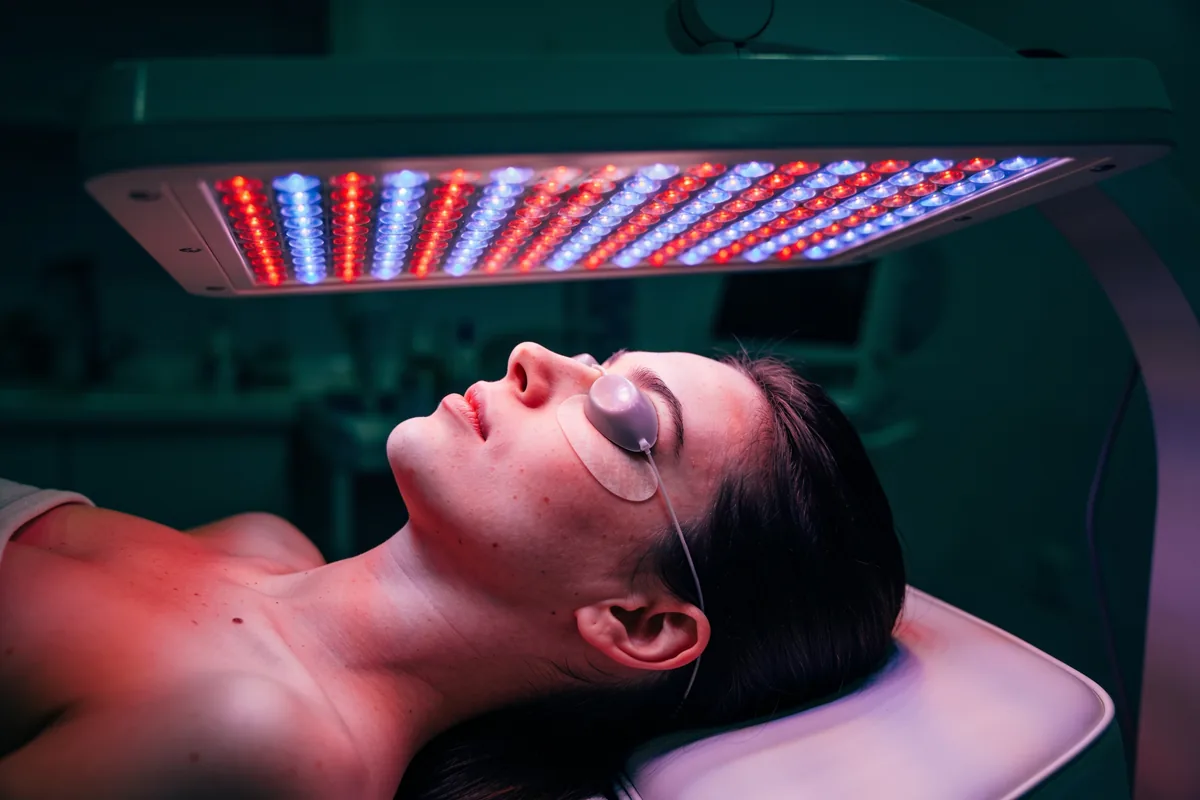
- As a low-labour session: if the device instructions allow it, the cosmetologist does not need to be present for the whole exposure, which makes scheduling easier. Eye protection for the client applies regardless.
- As part of a package: the low cost of materials means you can use it to enrich the offer instead of lowering the price.
This last point tends to be underrated. Adding an LED session to a package raises the value of the offer in the client’s eyes and costs mainly device time, which works better than a discount, as we cover in the article on treatment passes and packages.
Safety and device parameters
The adverse effects of LED light therapy described in studies were mild and included temporary pigmentation changes, dryness, erythema, flaking and a burning sensation. The review authors mention a theoretical risk associated with blue light, whose range is close to UVA radiation, noting that no such consequences were confirmed in observations lasting up to eighteen months. Eye protection for the client and staff remains standard, as does caution with people taking photosensitising medication and those with conditions involving photosensitivity.
When buying a device, ask about wavelengths, power density, recommended exposure time and distance from the skin, and also whether the manufacturer states these values or only programme names. A detailed review of studies on LED in dermatology was published in the journal Lasers in Surgery and Medicine.
Colours of light and what is attributed to them
In manufacturers’ materials LED light therapy is broken down into colours, each with an assigned function, and clients often ask about them directly. Their origins differ. Blue light has the best described mechanism in acne, because it acts through bacterial porphyrins. Red light and near infrared penetrate deeper and are studied in the context of healing and repair processes. Green and yellow light are attributed to hyperpigmentation and redness, but the evidence in these indications is the most modest of the whole set.
Remember that colour alone does not determine the result. Two devices emitting light of the same colour can differ in power density several times over, and it is power density together with exposure time that decides the dose. That is why comparing devices by their list of colours is misleading, and the full technical specification remains the only sensible criterion.
The most common questions about LED light therapy
How many LED light therapy sessions are needed for acne?
Studies usually used series counted in weeks, with several sessions a week. A single treatment has no therapeutic purpose, although it can be a pleasant way to close a visit.
Do home-use masks work the same way?
Home devices usually have a lower power density and different parameters from salon equipment, and manufacturers rarely state them. Without these data a comparison is impossible.
Will LED light therapy help with wrinkles?
The evidence in this indication is weak. You can talk about support for skin condition, but not about wrinkle reduction as an effect confirmed by studies.
For the salon in brief: LED light therapy has decent research support in acne and support for healing, and weak support in rejuvenation. It works best as part of a protocol and a package. When buying, ask about wavelengths and power density, because programme names say nothing about the dose.
Would you like to add LED light therapy to your existing protocols? Book a free consultation and see este:med devices in Este Sklep.