
Cellulite treatments in the salon sell well, and the scientific evidence behind them is among the weakest in the whole of cosmetology. These two things can be reconciled by changing the language: instead of promising to remove cellulite, describe what improves the appearance of the skin and how long that effect lasts.
What is known about the phenomenon itself
Cellulite occurs in the great majority of women after puberty, most often on the thighs, buttocks and hips. It is neither a disease nor an indicator of excess weight, because it is also described in slim people. Its aetiology is not fully understood and is probably multifactorial. Review authors draw attention to the central role of the fibrous connective tissue septa, which tether the skin and create the characteristic dimples, and methods targeting adipose tissue alone do not give lasting results.
Review authors point to the connective tissue septa as the best justified target of therapy, because methods acting on adipose tissue alone do not give lasting results.
What reviews of studies show
The picture is consistent and calls for humility. In a 2015 review, of sixty-seven studies analysed fewer than a third had randomisation and a placebo group, and the authors concluded that there is no clear evidence of good efficacy for any method. Signals of benefit at the time concerned acoustic wave therapy and a laser with a wavelength of one thousand four hundred and forty nanometres. A more recent review of randomised studies lists shock wave therapy, radiofrequency and injectable solutions as promising, with the quality of evidence rated as moderate and an average follow-up counted in weeks. An analysis of electrophysical methods showed that of more than thirty studies only two had robust methodology.
Data on cosmetics are more modest still. A meta-analysis of studies on products containing, among other things, caffeine and retinoids showed a mean difference in thigh circumference of a few millimetres, with high heterogeneity of results. This is an effect that is statistically measurable and hard to notice in the mirror. The situation with massage is similar: in a study comparing three techniques, thigh circumference decreased on average by about half a centimetre, with no group left without an intervention.
What must not be promised
- Removing cellulite: no review confirms lasting elimination of the phenomenon.
- Burning fat with a cream: the evidence concerns a few millimetres of circumference, not a reduction in adipose tissue.
- Detox and cleansing the body: this is language with no basis in physiology, and it exposes the salon’s communication to an accusation of misleading.
- Lasting results after a series: most studies end follow-up after a few weeks, so data on durability are simply lacking.
- Equating cellulite with excess weight: apart from being factually inaccurate, this is a message that can hurt a client.
Caution in language also has a practical dimension: a promise of a lasting loss of centimetres comes back as a complaint after the series ends.
How to sell body firming without overselling
Start by changing the promise. Instead of cellulite reduction, offer a programme to improve the comfort and appearance of the skin: hydration, a smoother surface, a feeling of lighter legs, better firmness. These are effects clients really feel and that can be maintained with regularity. Add the dimension that no treatment provides in isolation from the rest: exercise, hydration, sleep. A salon that talks about this comes across as credible.
Then set the measures. Photographs in the same light and position, circumference measurements at marked points, a short well-being questionnaire. That way the conversation after the series rests on material and not on impressions. Body series are long and dense, so absences break them up most, which we cover in the article on no-shows in the salon. We describe the mechanics of packages and settling series in the article on treatment passes and packages, and the rules for choosing home care in the article on retail sales in the salon.
What actually happens during a treatment
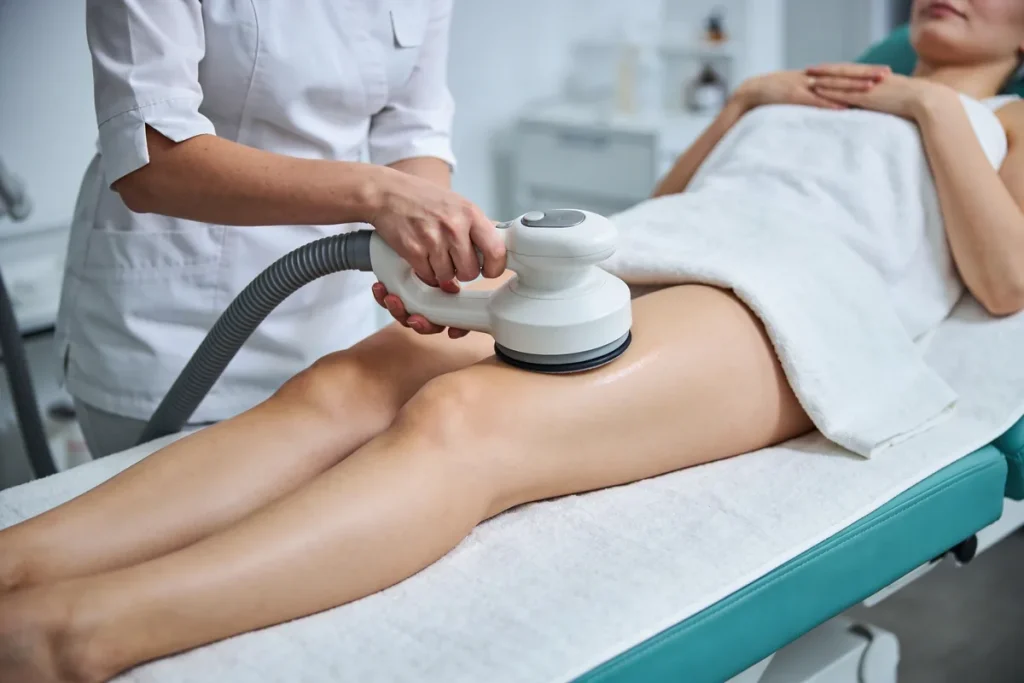
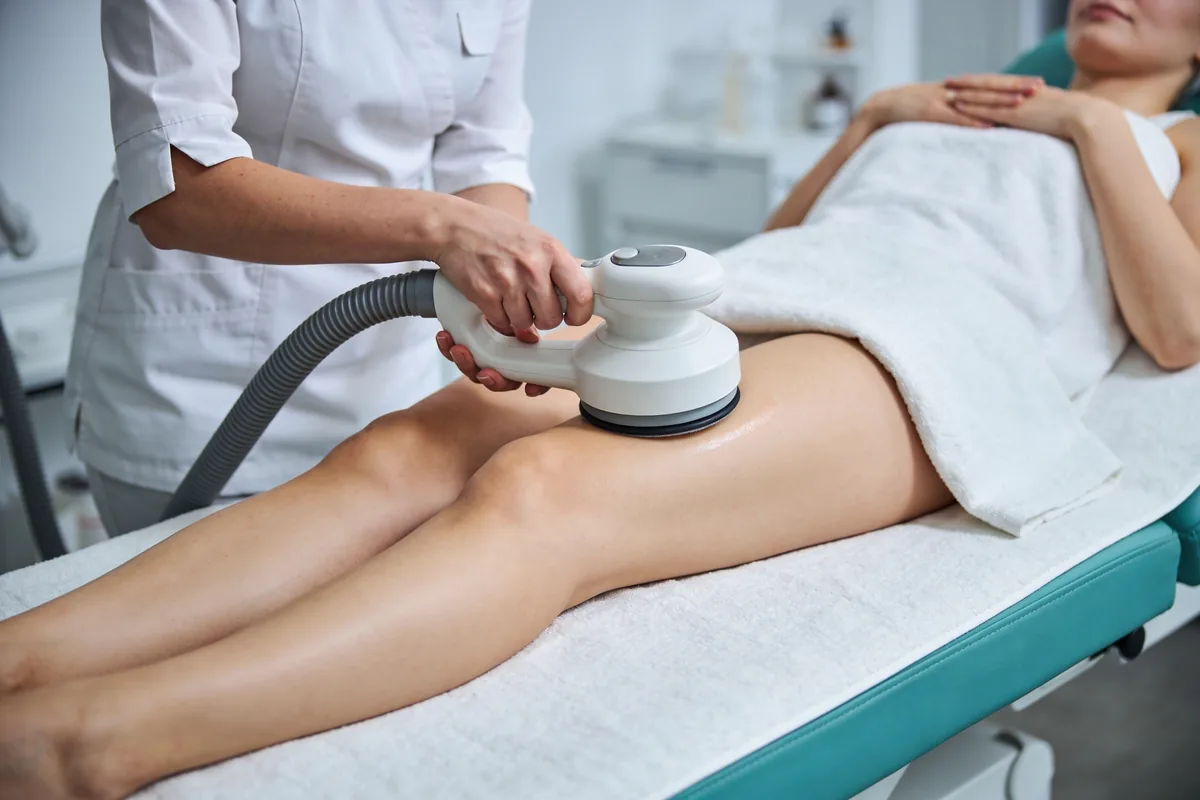
It is worth understanding what the individual methods act on, because that makes an honest description on the price list easier. Mechanical and vacuum massage works on the subcutaneous tissue and on circulation, improving fluid drainage and giving temporary smoothing of the surface. Shock wave therapy acts on connective tissue and performs best in studies among salon methods. Radiofrequency works through controlled heating of the tissue and a repair response, and whether it may be used depends on the documentation of the specific device. Cosmetics with caffeine and retinoids work at the level of the epidermis and microcirculation, with an effect measured in millimetres of circumference.
None of these methods removes the connective tissue septa responsible for the characteristic dimpling of the skin. This explains why the results are moderate and why they return after the series is stopped. A client who hears about this mechanism at the first visit judges the result after eight treatments differently and more often comes back for maintenance instead of looking for a salon that promises more.
When to refer a client to a doctor
Not every change on the thighs and lower legs is cellulite. Asymmetrical, painful swelling, a feeling of heaviness that builds up during the day, visible vascular changes or tenderness require medical assessment before you offer any compression or mechanical treatment. This is the same principle we describe in the article on skin diagnostics in the salon: recognising the moment to refer is part of competence. A review of the evidence on methods used for cellulite was published in the American Journal of Clinical Dermatology.
The most common questions about cellulite treatments
Which method has the best evidence?
In more recent reviews, shock wave therapy and radiofrequency perform best, with the quality of evidence rated as moderate and short follow-up. With radiofrequency, remember that the documentation of the specific device decides whether a cosmetologist may use it.
How many treatments make sense in a series?
Studies usually use series of a dozen or more treatments at a rhythm of two a week. With shorter cycles it is hard to expect a noticeable difference.
Will the result last after the series ends?
Long-term data are lacking, so the honest answer is: the result needs maintaining, both through treatments and through lifestyle.
For the salon in brief: the evidence for all methods is weak, and shock wave therapy has relatively the best, alongside radiofrequency, whose scope of use is set by the device documentation. Sell an improvement in appearance and comfort, measure results with photographs and circumferences, and give up the promise of removing cellulite.
Would you like to build a body programme based on realistic promises? Book a free consultation and see the Este Group offer.