Forms of vitamin C in cosmetics differ in stability, required pH, solubility and tolerance so much that the same ingredient on the label can mean a completely different product. L-ascorbic acid has the best documented action and the most requirements. Derivatives are gentler and more stable, but have fewer clinical studies. Matching the form to the client’s skin starts with understanding this difference.
L-ascorbic acid: the reference point for the other forms
Of the forms in which vitamin C occurs in cosmetics, L-ascorbic acid is the biologically active one and the only one that acts directly, without conversion in the skin. In a 2001 study by Pinnell’s team on pig skin, L-ascorbic acid penetrated the skin only in a solution with a pH below 3.5, and the best absorption was obtained at a concentration of 20%. Higher concentrations did not improve it. The tissue level reached saturation after three days of daily application, and the half-life was about four days (Pinnell et al., Dermatologic Surgery 2001).
In the same study, magnesium ascorbyl phosphate, ascorbyl palmitate and dehydroascorbic acid did not raise the level of L-ascorbic acid in the skin. Hence the concentration range of 10 to 20% adopted in practice and the low pH of the serum. The price is poorer tolerance: an acidic product can sting and, with a compromised barrier, cause erythema.
With vitamin C the label says less than the formula. What counts is the chemical form, the pH, the concentration and what the product is packaged in.
Forms of vitamin C in cosmetics: derivatives and their properties
Derivatives, that is the remaining forms of vitamin C in cosmetics, were created to get round the instability of L-ascorbic acid. Most of them have to be converted in the skin into the active form, and the efficiency of that process in humans is less well described than the action of the acid itself.
- Sodium ascorbyl phosphate (SAP): water-soluble, stable at a near-neutral pH, well tolerated. In an open-label study of 60 people, a lotion with 5% SAP was used for 12 weeks by people with acne; the authors of the study were employees of the raw material manufacturer, which has to be taken into account (Klock et al., 2005).
- Magnesium ascorbyl phosphate (MAP): also water-soluble and stable. In a 1996 study, a cream with 10% MAP produced significant lightening in 19 of 34 people with melasma or solar lentigines (Kameyama et al., 1996).
- Ascorbyl tetraisopalmitate: an oil-soluble form, usually listed in INCI as tetrahexyldecyl ascorbate. It copes well with oil-based and anhydrous formulas and does not require a low pH.
- Ascorbyl glucoside: water-soluble, releases ascorbic acid under the action of skin enzymes. It is regarded as gentle and well tolerated in long-term work on hyperpigmentation.
- Ethylated ascorbic acid (3-O-ethyl ascorbic acid): stable, common in brightening products. Clinical data are clearly more modest than for L-ascorbic acid.
Stability, oxidation and packaging
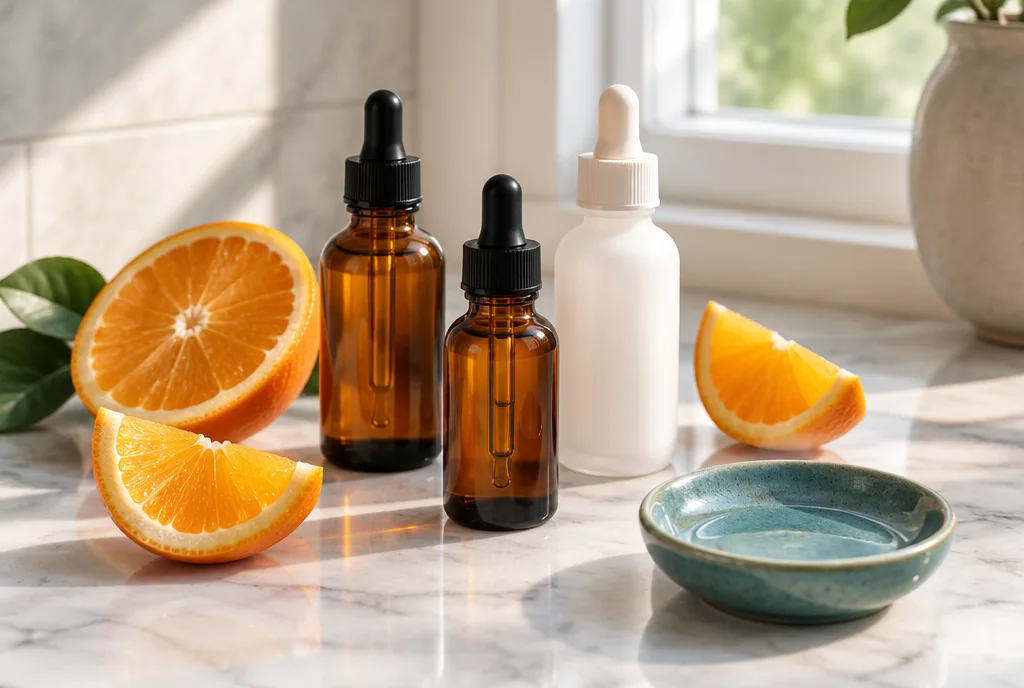
Vitamin C loses activity fastest in water-based cosmetics: L-ascorbic acid in solution oxidises under the influence of oxygen, light, heat and metal ions. The first visible sign is a change of colour from colourless or straw-coloured to yellow and then brown. A serum in this state loses activity, although it still looks like a product ready for use.
More stable forms of vitamin C in cosmetics also age after opening, only more slowly. When buying for the salon and for retail, pay attention to several parameters:
- Packaging: opaque or dark glass, a pump or airless instead of a dropper opened every day.
- Volume: a smaller bottle used up in a few weeks is safer than a large one open for six months.
- Formula: anhydrous products, powders dissolved before use and lipophilic derivatives withstand storage better than a water-based serum with pure acid.
- Storage in the salon: away from the lamp, the steriliser and the steamer; the opening date on the packaging.
Matching the form to the client’s skin
Forms of vitamin C in cosmetics are matched to the goal and the condition of the epidermal barrier, and only then to the concentration.
- Sensitive skin and skin prone to redness: ascorbyl tetraisopalmitate, ascorbyl glucoside or SAP at a lower concentration. Introduce L-ascorbic acid cautiously, from lower concentrations and every other day.
- Acne-prone skin: SAP in a light, water-based formula; check the oil carriers of lipophilic derivatives for the comedogenicity of the whole formulation.
- Mature skin: L-ascorbic acid from 10 to 20% at a low pH, if the skin tolerates it. This form has the most data on photoageing, which we cover in more detail in the article on what science means by skin quality.
- Hyperpigmentation: L-ascorbic acid, MAP or ascorbyl glucoside as part of longer-term care, always with daily photoprotection. We describe treatment protocols in the article on hyperpigmentation and melasma in the salon.
Vitamin C in cosmetics with ferulic acid and vitamin E
Vitamin C in cosmetics most often works in a pair with vitamin E, because the two regenerate each other. In a 2005 study, adding ferulic acid to a solution of 15% L-ascorbic acid and 1% alpha-tocopherol improved the chemical stability of the vitamins and doubled the protection of the skin against radiation from about fourfold to about eightfold, measured by erythema and the number of sunburn cells (Lin et al., Journal of Investigative Dermatology 2005).
This result concerns a specific formulation and experimental conditions, so treat it as an argument for the combination itself. Every product with these three ingredients is assessed separately, by pH, concentrations and packaging. When combining with other active substances, pH and the order of layers matter; we describe the rules for copper peptides in the article on GHK-Cu in cosmetics.
Vitamin C in salon cosmetics
A 2026 systematic review covering 44 papers on how vitamin C works in cosmetics identifies L-ascorbic acid as the form best documented clinically and notes that treatments increasing penetration, such as microneedling, improved the results of derivatives. The authors also stress the great diversity of the studies and the small amount of data for different phototypes (Boghosian et al., 2026).
In salon practice you will use forms of vitamin C in cosmetics at three stages: in treatment ampoules and masks, in home care between visits and in brightening protocols. On skin immediately after a treatment that disrupts the barrier, gentle derivatives work better, and an acidic serum with L-ascorbic acid returns to the routine once the barrier has been rebuilt. Well-chosen professional cosmetics for the salon let you guide the client with one line from the treatment through to home care.
How to read INCI and compare forms of vitamin C in cosmetics
You recognise forms of vitamin C in cosmetics in the ingredient list by their INCI names, which on the label rarely match the claim on the front of the packaging. The words “vitamin C 15%” may mean L-ascorbic acid, but just as well a derivative whose molecular weight is higher, so the same percentage delivers less ascorbic acid. The first step in assessing a product is to read which form stands behind the number.
| Form | INCI name | Solubility | pH of the formula |
|---|---|---|---|
| L-ascorbic acid | Ascorbic Acid | water | pH below 3.5 |
| Sodium ascorbyl phosphate | Sodium Ascorbyl Phosphate | water | near neutral |
| Magnesium ascorbyl phosphate | Magnesium Ascorbyl Phosphate | water | near neutral |
| Ascorbyl glucoside | Ascorbyl Glucoside | water | slightly acidic |
| Ethylated ascorbic acid | 3-O-Ethyl Ascorbic Acid | water | slightly acidic |
| Ascorbyl tetraisopalmitate | Tetrahexyldecyl Ascorbate | oils | anhydrous formulas and emulsions |
| Ascorbyl palmitate | Ascorbyl Palmitate | oils | anhydrous formulas and emulsions |
The INCI list gives ingredients in descending order of concentration, and below the 1% threshold in any order. If vitamin C in a cosmetic declared as a “serum with 20% vitamin C” comes after glycerine, fragrance and a preservative in the list, the declaration needs clarifying with the manufacturer. Also check the ingredients that protect the formula: ferulic acid and tocopherol as antioxidants, and substances that bind metal ions, for example Disodium EDTA or phytic acid, which slow down oxidation catalysed by iron and copper.
With L-ascorbic acid products, ask the distributor about the pH of the finished product. A serum with a pH of 5 or higher that declares a high concentration of L-ascorbic acid no longer meets the penetration condition described in Pinnell’s study. Derivatives have different requirements, so their assessment rests on concentration, stability and the manufacturer’s data. Vitamin C in anhydrous cosmetics and in powders dissolved just before use keeps its activity longer, which for salon purchasing means fewer withdrawn packs.
Vitamin C in cosmetics and other active ingredients
Vitamin C in cosmetics rarely works alone, and a client’s care plan usually also contains a retinoid, acids or niacinamide. Three parameters decide which combinations to leave at the same time of day: the pH of both products, the risk of cumulative irritation and chemical reactions between the ingredients.
- Retinoids: the standard arrangement is vitamin C in the morning, under sunscreen, and a retinoid in the evening. Separating them reduces the load on the skin and lets each product work at its own pH.
- AHA and BHA acids: L-ascorbic acid and an acid toner at the same time of day add up low pH and the risk of stinging. Separate them into morning and evening or onto different days, especially with thin skin prone to redness.
- Benzoyl peroxide: as a strong oxidiser it breaks down ascorbic acid. A client with acne who uses it on a doctor’s recommendation applies vitamin C at a different time of day.
- Niacinamide: concerns about this combination stem from older observations of pure solutions. In finished formulations the two ingredients often occur together. With reactive skin you separate them into morning and evening, to make it easier to establish the source of any irritation.
- Copper peptides: ascorbic acid reduces copper ions and can weaken the action of both ingredients, which is why you use them at different times of day.
- Sunscreens: an antioxidant complements photoprotection but does not replace it. You always apply a cream with SPF 30 or 50 over the serum as the last layer.
Record the agreed plan on the client card, divided into morning and evening. You change forms of vitamin C in cosmetics in it only when the earlier form causes stinging, erythema or no result after a full cycle of use.
The most common mistakes when working with vitamin C
Most problems with this ingredient come from storage and the order of layers, and less often from the formula itself. In the salon, forms of vitamin C in cosmetics require the same habits as other sensitive raw materials: checking the opening date, the colour and the temperature.
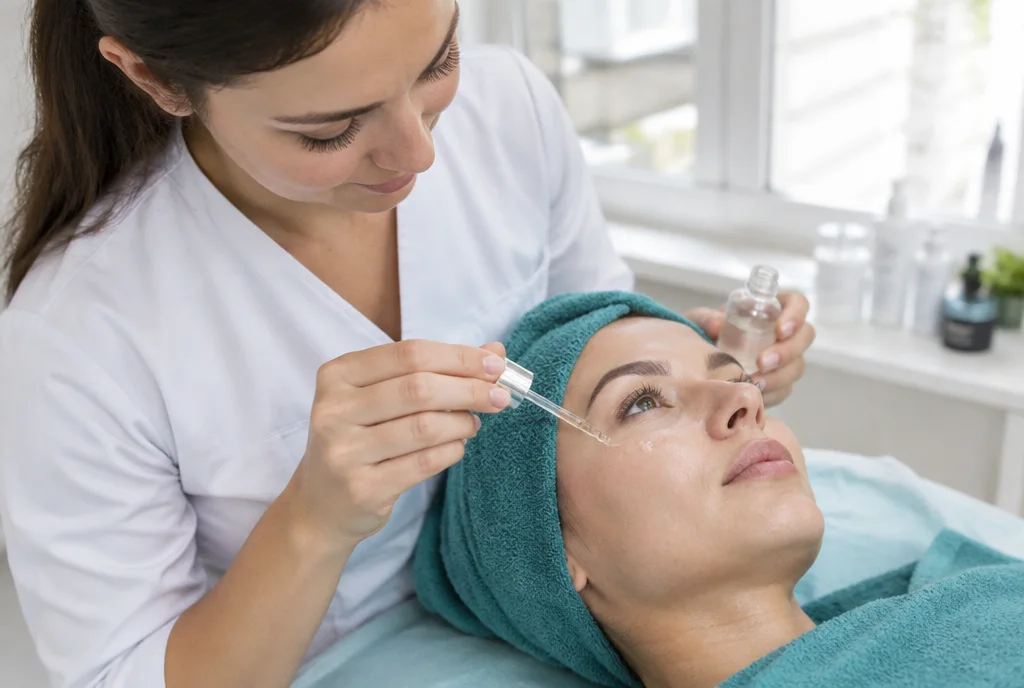
- Contact between the dropper and the skin: a pipette touching the face carries contaminants into the bottle and speeds up spoilage of the product. You apply the drops to your fingertips or a spatula.
- A bottle by the window or lamp: a serum on a shelf in the sun or next to the steriliser loses activity faster than in a cupboard at a constant room temperature.
- Too much product: an excess of acidic serum increases stinging without improving penetration. 3 to 5 drops are enough for the face.
- L-ascorbic acid for skin with rosacea: vitamin C in cosmetics with a pH below 3.5 often intensifies stinging with this skin, so you start with a gentle derivative.
- An old batch on the retail shelf: check the expiry dates and the colour of the tester, because the client will judge the product by the first pack.
A treatment protocol with vitamin C
In the salon you choose forms of vitamin C in cosmetics according to the condition of the skin at a given stage of the treatment. Skin with an intact barrier takes a serum with L-ascorbic acid well, while skin after exfoliation or microneedling tolerates near-neutral derivatives better. The scheme below concerns a brightening and antioxidant facial treatment.
- Cleansing and toning: a gentle cleanser and an alcohol-free toner. Before an acid treatment you degrease the skin in line with the peel manufacturer’s instructions.
- Exfoliation: an enzyme peel or a superficial acid peel, matched to the phototype and reactivity of the skin. We describe the rules for choosing concentrations in the article on hyperpigmentation and melasma in the salon.
- Introducing the ingredient: a sterile ampoule with a vitamin C derivative for microneedling, or a serum for massage and treatments that do not disrupt the epidermis. For microneedling you use only a product the manufacturer has described as intended for this technique.
- Mask and finish: a soothing mask for 15 to 20 minutes, a ceramide cream and SPF 50 sunscreen.
When to postpone a vitamin C treatment
Move the appointment in the case of an active flare-up of rosacea, fresh sunburn, active cold sores in the treatment area and irritation after home-use acids or retinoids. If the client has previously reported an allergy to any ingredient of the product, carry out a patch test behind the ear or on the inside of the forearm and assess it after 48 hours. You refer a client with a pigmented lesion that has an irregular border or is growing quickly to a dermatologist before starting the series.
Vitamin C in salon cosmetics also requires discipline in storing opened packs. You use up an ampoule on one client, and you withdraw an opened serum that has changed colour before the next treatment.
Home plan, seasonality and assessing the result
Vitamin C in home-care cosmetics works with regular use, so the plan for the client should be simple to carry out every day. You apply the serum in the morning to cleansed, dry skin, 3 to 5 drops for the face, and after it has absorbed, cream and sunscreen. With sensitive skin, start with use every other day for the first two weeks and increase the frequency if no stinging or erythema appears.
- Autumn and winter season: lower UV intensity makes brightening series easier to run, which is why from October to March it is easier to combine vitamin C with salon peels.
- Spring and summer: forms of vitamin C in cosmetics stay in the routine as an antioxidant under sunscreen, and you limit exfoliation in the salon to gentle protocols.
- Stock at home: the client buys a pack she will use up within 6 to 8 weeks and stores it away from bathroom heat and light.
In retail sales, match the home product to the form used in the salon or to a gentler form. A client who, after a treatment with a derivative, is given a serum with 20% L-ascorbic acid to take home more often reports stinging and stops the routine. You discuss forms of vitamin C in home-care cosmetics with the packaging in your hand: you show the INCI name, the expiry date and where to store it.
How to measure the result of work with vitamin C
Assess the brightening effect after 12 weeks at the earliest, because that is the horizon over which, for example, the sodium ascorbyl phosphate study described above was run. Take photographs in the same light and from the same distance, and if you have a cross-polarised lamp, use it to document hyperpigmentation, because it limits reflections from the skin surface. A Mexameter lets you record the melanin index and erythema index on the card at the same points on the cheek at every visit.
You have the conversation about expectations before the first treatment, showing the client which forms of vitamin C in cosmetics you have chosen for her skin and why. Vitamin C in cosmetics evens out skin tone and supports the skin in protecting itself against oxidative stress, while hyperpigmentation located deeper, in the dermis, responds more weakly and more slowly. Agree the baseline photograph with the client as the reference point, and discuss progress on comparison photographs after the series has ended.
The most common questions about forms of vitamin C
Which concentration of L-ascorbic acid should I choose?
The accepted range is 10 to 20%. In penetration studies 20% gave the maximum, and higher concentrations did not improve penetration but do increase the risk of irritation.
Is a serum that has darkened fit for use?
A yellow-brown colour means oxidation of the ascorbic acid and a drop in activity. It is better to withdraw such a product from use in the salon and from the retail shelf.
Do vitamin C derivatives act more weakly?
They have fewer clinical data and act after conversion in the skin, but they are more stable and better tolerated. For sensitive skin they can be a more sensible choice than a low-pH acid.
Can vitamin C be used together with retinol?
It can, but at different times of day: vitamin C in the morning under sunscreen, a retinoid in the evening. This separation limits cumulative irritation and lets each product work at its own pH. With mature skin you can keep this arrangement all year round, provided there is daily photoprotection.
Which form of vitamin C works after microneedling?
For skin with open channels, near-neutral derivatives are more suitable, in a sterile ampoule intended by the manufacturer for this technique. Low-pH L-ascorbic acid returns to the routine once the barrier has been rebuilt, which usually means after a few days. The manufacturer indicates in the instructions which forms of vitamin C in cosmetics are approved for work with needles, so you check them before every new product.
For the salon in brief: forms of vitamin C in cosmetics differ in their level of evidence. L-ascorbic acid from 10 to 20% at a pH below 3.5 has the best data, but requires skin tolerance and good packaging. SAP works well for acne-prone skin, lipophilic derivatives and ascorbyl glucoside for sensitive skin, and with hyperpigmentation vitamin C works together with photoprotection. Dark, airtight packaging and checking the colour of the product are the basics.
Would you like to match forms of vitamin C in cosmetics to the protocols in your salon? Book a free consultation and see the professional cosmetics for salons in the Este Group range.