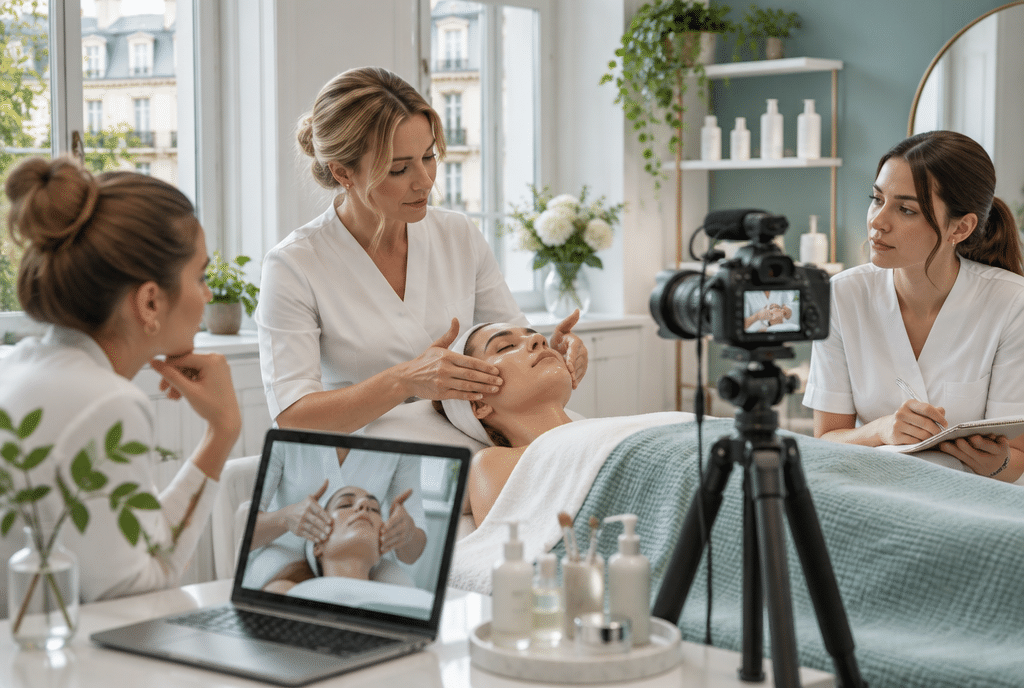
A client will forget which product you used. She will remember whether she felt looked after. This sentence sounds like a slogan from a motivational training course, but hard economics stand behind it: customer service in a beauty salon decides return visits, and return visits decide whether the salon earns money or merely turns it over.
The problem is that in the industry service is treated as a character trait. Either someone has a way with people or they do not. Yet everything a client perceives as professionalism can be broken down into specific actions that every person on the team can be taught. Below is such a breakdown, from the first message to a situation in which someone is unhappy with the result.
In brief
- Service is a procedure, not a talent. A written standard will survive team turnover; good intentions will not.
- Most clients are lost before the visit, at the stage of unanswered messages and a price list hidden from the world.
- The consultation and post-treatment recommendations weigh more than the treatment itself, because they are what build a sense of care.
- Promotions on the price list are subject to regulations on price information, which a minority of salons remember.
Service is a procedure, not character
Salons where service is consistent have one thing in common: someone once sat down and wrote out what a visit looks like from start to finish. How many rings before the phone is answered, what is said in the first sentence, where the client puts her coat, when she gets water, what she hears as she leaves.
It sounds rigid until you see the alternative. Without a standard every person on the team improvises, and the client gets a different experience each time and never knows what to expect. Attachment is then built not to the salon but to a specific cosmetologist, which, when she leaves, ends in the loss of part of the client base.
A standard does not take away personality. It takes away the risk that on a bad day a client gets a worse version of your salon.
First contact, the place of the greatest losses
Before anyone crosses the threshold, service is already under way. A message on Instagram at ten in the evening, a phone call in the middle of a treatment, a form on the website. That is where most people are lost, and the loss is invisible, because it leaves no trace in the calendar.
Three things worth setting up once and no longer thinking about. First, one main contact channel, handled at specific times and communicated plainly, instead of four channels handled chaotically. Second, price ranges available without asking, because sending people to a private message for the price means, for some, the end of the conversation. Third, online booking that works when the client is thinking about it, that is in the evening and at the weekend.
What a message confirming a visit should contain
- The name of the treatment, the date, the time and the expected duration.
- The exact address with a tip on where to park or which side to enter from.
- Brief preparation: what not to do before the treatment, whether to come without make-up.
- The price and accepted forms of payment.
- The rules for cancelling a visit, worded once and applied consistently.
A reminder the day before is the cheapest tool for reducing missed visits that exists. One message instead of an empty hour in the schedule.
The consultation: questions that change the outcome of the treatment

The consultation is the part of the visit that is easiest to cut short when the schedule is falling apart, and the one whose shortening costs the most. It is there that the decision whether the client will come back is made, because only there does she learn what she can expect.
Four questions that change the conversation:
- What worries you most about your skin?
- What have you tried before, and how did it end?
- How much time can you realistically give to skincare at home?
- Is there an event you want to look good for, and when?
The last question can be the most important, because the answer determines whether a treatment with downtime may be offered at all.
The consultation also contains the hardest thing: saying that an expectation is unrealistic. A client counting on the effect of a filler after a series of skincare treatments will be disappointed whatever the quality of the work. It is better to lose one treatment than to gain a dissatisfied person who will tell ten friends about it. What helps here is arranging the offer beforehand so that every item has a clearly described goal, which we cover in the article on the treatment menu in the salon.
During the treatment: fewer words, more signals
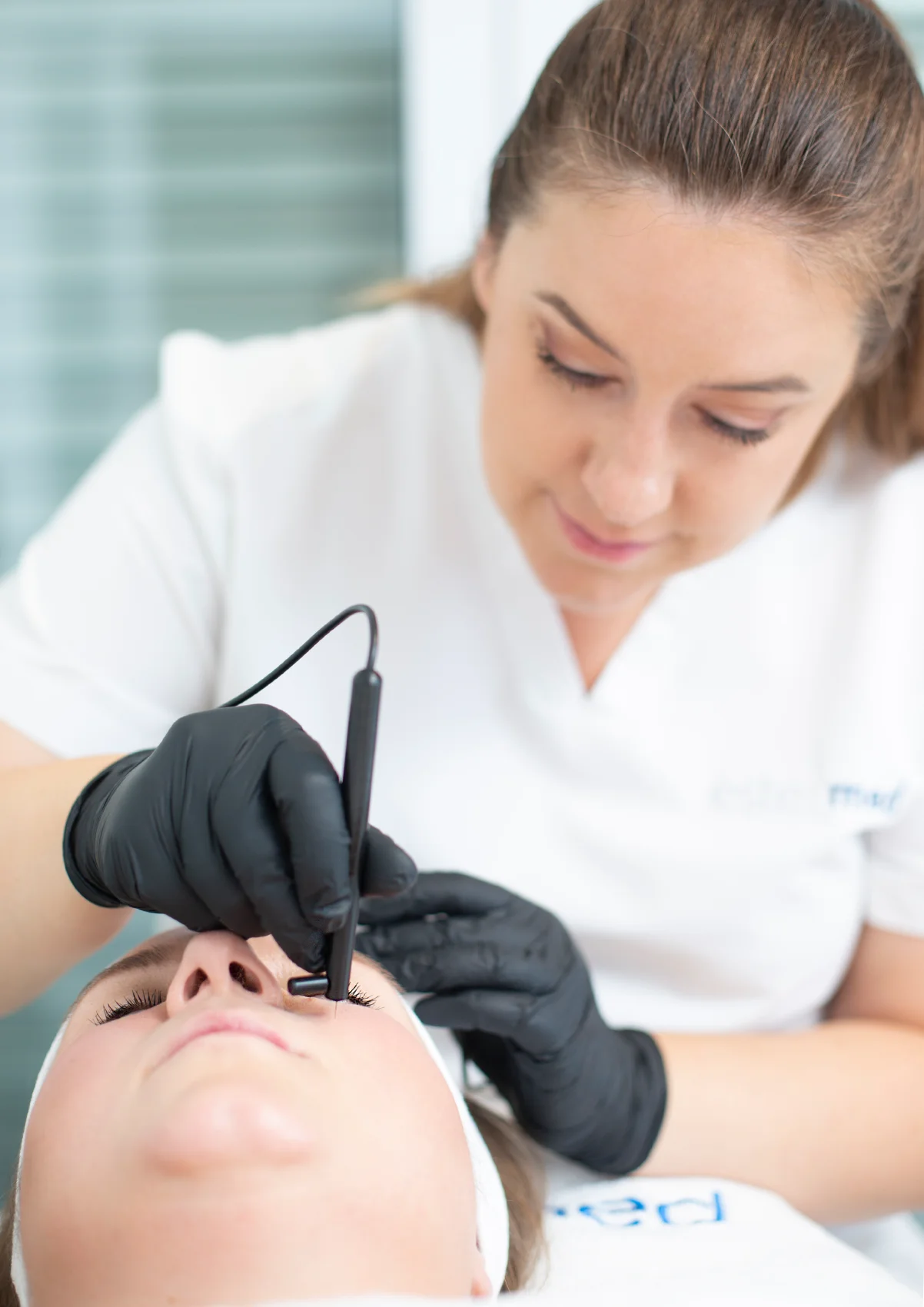
During the treatment a rule applies that is routinely broken in the industry: this is not time for your conversation but for the client’s comfort. Some people want to talk, some have come for an hour of silence. One question at the start is enough to settle it.
Three things worth saying every time:
- “I am going to apply the product now; it may sting slightly for a moment.” An announcement before the action, not after.
- “We are about halfway through.” Knowing where you are in time lowers tension.
- “Let me know if it is too strong.” Repeated once during the treatment, not only at the start.
Add to this things that seem minor: the temperature in the room, a blanket, the phone silenced and put away, a door that nobody opens in the middle of the treatment.
The end of the visit, the most underrated five minutes
The client gets up from the chair, is pleased with the result and is at her most open to what you say. In most salons these five minutes look like this: payment, “see you”, the door. The only moment in the whole visit when everything you propose sounds natural is wasted this way.
- Sum up what you did in one sentence, without specialist jargon. The client must be able to repeat it at home.
- Hand over the recommendations in writing. A card with the things to avoid over the coming days costs pennies and protects the result the client has just paid for.
- Suggest home care as part of the protocol, not as an add-on sale. Two products with a justification work better than a long list.
- Book the next visit straight away, giving a specific date that follows from the protocol, instead of asking her to get in touch.
- Record on the client card the parameters, the skin’s reaction and what you talked about privately. At the next visit this will make a better impression than any loyalty programme.
We develop point three in more detail in the guide to retail sales in the salon, and the choice of products for the repair phase in the article on care after aesthetic treatments.
The price list and promotions: where service meets the regulations
This part surprises the most owners, because it sounds like a subject for online shops, yet it concerns every salon announcing a reduction.
Before you announce your next promotion
- In Poland, since 1 January 2023, every announcement of a reduction in the price of a service must be accompanied by the lowest price of that service in the 30 days before the reduction.
- The obligation also applies to discount codes and reductions in loyalty programmes, not only to a crossed-out price on a poster.
- Prices on the price list are given gross, with the type and scope of the service specified.
- Where the price list on the website differs from the price list in the salon, the consumer may demand the price more favourable to them.
The last point is the most common real problem: last year’s price list on the website, the current one at reception and a third in the description of a post from a month ago. Guidance on price reduction announcements is published by the Office of Competition and Consumer Protection (UOKiK). We described the method for setting the rates themselves in the article on cosmetic treatment prices.
Lateness, cancellations and empty slots
Rules make sense only when they are the same for everyone and communicated in advance. A rule invented in the moment of conflict always looks as if it is aimed at a specific person.
Lateness
Set a threshold after which the treatment is shortened, not moved at the expense of the next client. Say so at booking, not at the door.
Cancellation
Give a specific time, for example twenty-four hours before the visit. For last-minute cancellations, consider a deposit for long and costly treatments.
A missed visit
Call the same day, calmly and without reproach. Some absences come from a mistake in the calendar, and a conversation saves the relationship.
Repeated absences by the same person are a signal to move to prepayment at the next booking. This is not a penalty but a condition of continuing to work together, and that is how it is worth wording it.
When a client is dissatisfied
Sooner or later it will happen to everyone. The difference between a salon that loses by it and one that comes out of it stronger lies entirely in the first two minutes of the conversation.
- Listen without interrupting and without making excuses as you go. A person who feels heard lowers their tone of their own accord.
- Establish the facts on the basis of the treatment card: what exactly was done, with what parameters, what recommendations the client received.
- Offer a solution before she asks for one. A follow-up consultation, a correction, a calming treatment and, in justified cases, a refund.
- Record the matter and come back to it after a few days. A phone call asking how the skin looks now can turn a complaint into a recommendation.
Never have this conversation publicly on social media. Reply briefly and factually that you are getting in touch directly, and deal with the rest out of view. We described the rules of public communication, including replying to reviews, in the article on local marketing for a beauty salon.
A standard that will survive team turnover
The last element is the dullest and the most neglected. Everything above has value when it exists outside your head.
Write out the course of a visit on two pages, attach message templates and the recommendations card, and make it the first document a new person on the team receives. Once a quarter, go through the client’s path yourself: write a message from a private account, try to book a visit online, check how long a reply takes. Things usually come out then that cannot be seen from the owner’s perspective.
Add training, but not only technical training. The ability to lead a consultation and a conversation about dissatisfaction translates into revenue as strongly as a new technology, and costs less. We have gathered directions worth considering on the training for cosmetologists page.
What not to do
Promise a result
A guarantee of a result is a straight road to a complaint. Talk about what can be expected after a series and about the factors that influence it.
Criticise the previous salon
The client will hear in it a forecast of how you will talk about her. A factual assessment of the condition of the skin, without comment on someone else’s work, is enough.
Leave silence after the visit
No contact after a series means that the next salon has an open door. One message after a week is enough.
The questions we get most often
How do I write a service standard if I work alone?
The same way, only shorter. One page with the course of a visit and message templates is enough. When you work alone, the document mainly protects against some steps quietly dropping out in a worse week.
Does taking a deposit put clients off?
With short treatments it is usually not worth it. With long and costly ones a deposit is common enough in the industry that it surprises nobody, as long as the rules are described in advance and applied to everyone.
What should I do when a client expects a result the treatment will not give?
Say so at the consultation, before the treatment, and offer what actually answers her need, even if that means referring her to a doctor. Disappointment after the fact costs far more than a lost visit.
Is written consent to a treatment necessary?
Consent and a history in written form are a standard that protects both sides, and with treatments that break the continuity of the epidermis it is hard to imagine working without them. The documentation contains health data, so it requires appropriate security and a basis for processing.
How often should the price list on the website be updated?
With every change in rates and always before announcing a promotion. A difference between the online price list and the one in the salon is not only an image problem but also a situation in which the consumer may demand the price more favourable to them.
Good service starts with an offer that can be explained clearly to a client. At Este Group we match professional cosmetics and devices to a specific treatment menu, and we prepare the team to work with the chosen protocols at our own training centre.
If you are arranging your offer from scratch, start with choosing professional cosmetics and check how to introduce a new service in the salon, so that the service standard is created together with the treatment and not two months after it.