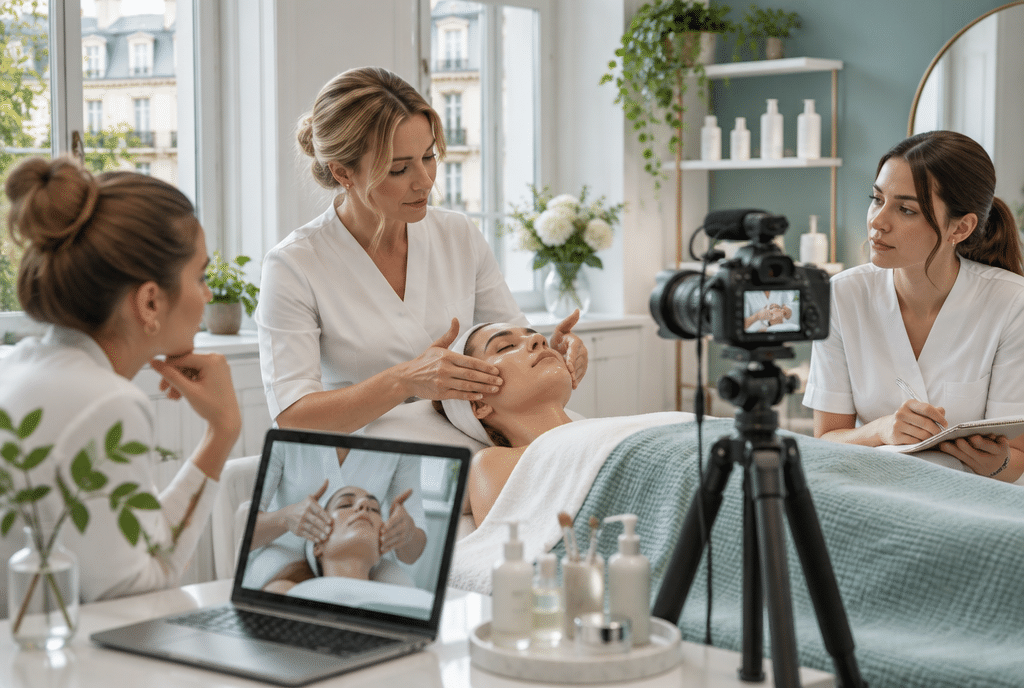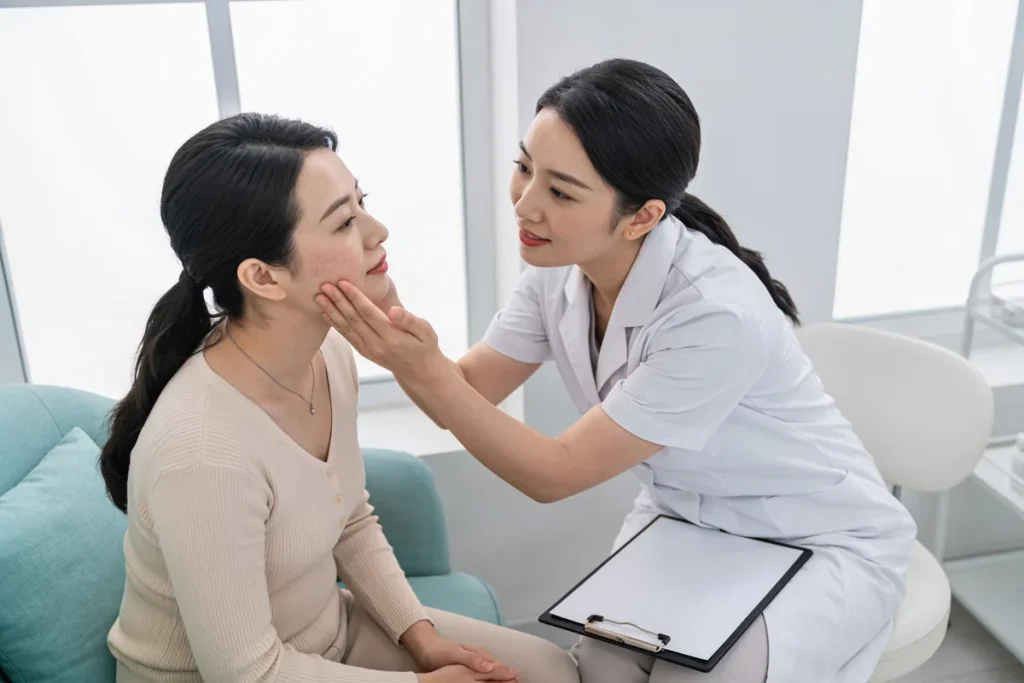

Skin diagnostics in the beauty salon needs clarifying at the outset, because a cosmetologist does not make a diagnosis. She assesses the condition of the skin, takes a history, chooses a course of action within her scope and recognises the moment when it has to be said: this needs a doctor. That last skill is often the most valuable and the least practised.
Skin diagnostics starts with the history
Skin diagnostics starts with a conversation, not with a device. You are interested in the history of the problem: since when, what makes it worse, what eases it, how it has behaved through the seasons. Next, home care, with product names and frequency, because most of the irritation that arrives at the salon as sensitive skin is the result of too many self-administered treatments. Then medication and supplements, with particular attention to photosensitising products and oral retinoids. Finally, previous treatments, allergies and expectations.
Skin diagnostics does not exist without notes. Record these answers on the card, because without a starting point it is impossible to judge whether anything has improved after three weeks. We describe how to keep records in line with the regulations in the article on GDPR in the beauty salon.
Visual assessment and phototype in skin diagnostics
In skin diagnostics the phototype is estimated with the Fitzpatrick scale, developed in 1975 and supplemented with types five and six in 1988, which describes the skin’s reaction to the sun on the basis of what the person reports: the tendency to burn and the ability to tan. It is not a description of skin colour or a substitute for ancestry, and its authors and later commentators point to significant limitations. Types one to four were created for fair skin, and in people with darker skin the questions about burning and tanning can be understood differently.
Skin diagnostics uses it despite these limitations, because the scale remains a useful approximation when assessing sensitivity to radiation and the risk of post-inflammatory hyperpigmentation. Treat it as a guide to choosing the intensity of a treatment, not as a label.
The salon’s task is to recognise that the picture of the skin goes beyond the scope of cosmetology, and to pass the client on.
Wood’s lamp and imaging analysis
A Wood’s lamp is a cheap and safe tool in skin diagnostics, but one that requires training in interpretation. Clinical publications describe characteristic fluorescence in some fungal and bacterial infections, with each colour of glow attributed to a different cause. Interpretation requires training and usually laboratory confirmation, because many fungi do not fluoresce at all, so the absence of a glow rules nothing out. The lamp is not, however, for assessing phototype, although it is sometimes used for that.
Imaging analysis systems sold as skin diagnostics can impress a client and can be a good demonstration tool. Reviews of this technology do, however, point to inconsistent protocols for taking the images, limited representativeness of the reference datasets and a lack of prospective validation. No device of this class replaces a dermoscopic examination by a doctor.
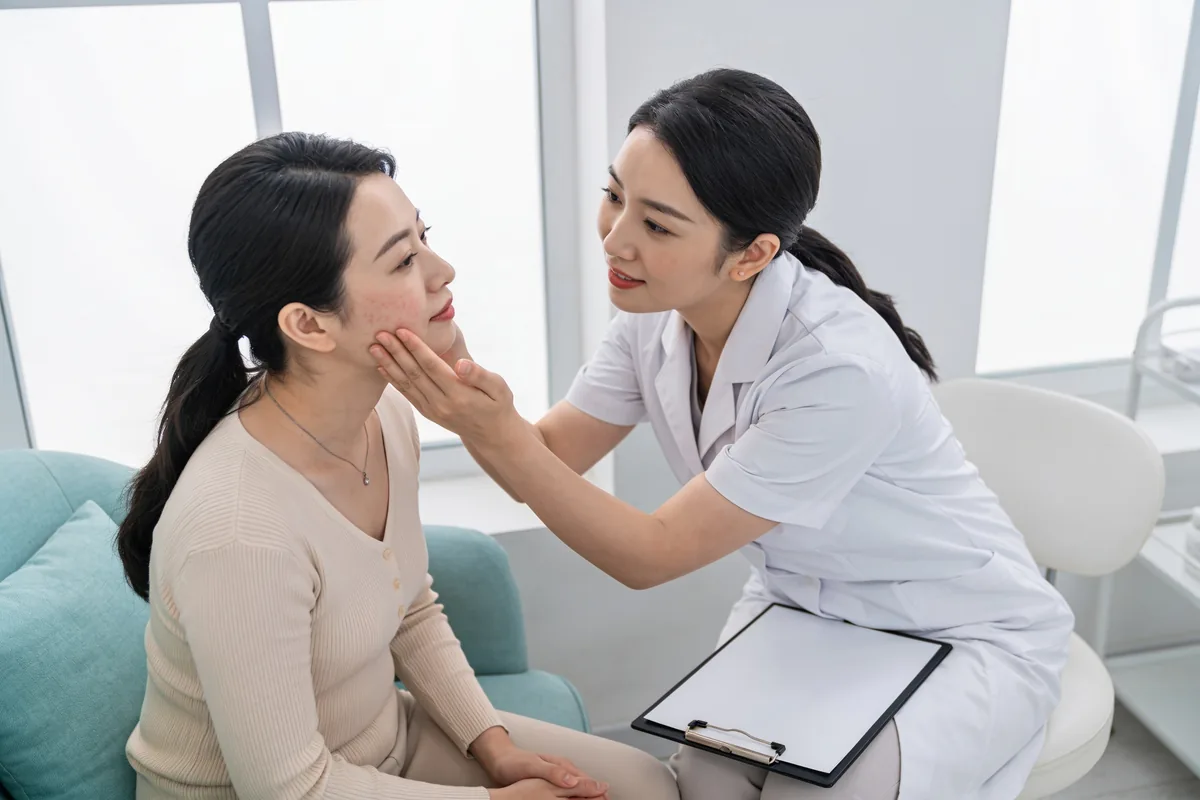
When to refer a client to a dermatologist
- A pigmented lesion meeting the ABCDE criteria: asymmetry, irregular borders, uneven colour, a diameter above six millimetres and, above all, evolution, that is a change in size, shape or colour, or the appearance of itching, tenderness or bleeding.
- A lesion that differs from the others: the ugly duckling rule, that is a mole clearly different from all the others on the same person.
- A wound that does not heal: persisting for weeks, recurring in the same place.
- Suspected skin disease: inflammatory lesions of unknown cause, infections, severe acne requiring systemic treatment.
- Sudden or one-sided hyperpigmentation: especially in a person taking new medication.
- General symptoms: fever, enlarged lymph nodes, feeling unwell alongside skin changes.
A referral is not a failure on the salon’s part. It is proof of competence and builds trust faster than any treatment. A practical aid is a short list of dermatology practices you have a good relationship with and a ready form of words that does not frighten the client but says clearly that assessing the lesion is beyond your scope.
How to close the consultation and the plan
Skin diagnostics makes sense when it ends with a plan, not a list of treatments. Say what you see, what you propose for the first stage, how you will both know it is working and when you will meet again. Write down the skincare recommendations, because the result of most protocols is decided between visits, which we cover in the article on retail sales in the salon. If the subject needs more depth, it is worth pointing to the materials on skin quality or to a specific protocol, for example care for acne-prone skin.
A practical account of the criteria for recognising pigmented lesions was published, among others, in a review on the early detection of melanoma, and the characteristics of the Wood’s lamp are described in a StatPearls publication.
Five questions that change the treatment plan
In skin diagnostics there are questions that come up most often in the history and most often change the decision. The first concerns sun exposure in the coming weeks, because a planned trip moves some protocols. The second covers medication, especially oral isotretinoin, tetracycline antibiotics and herbal products with a photosensitising effect. The third is the question about recurrent cold sores, important before any treatment that disrupts the barrier. The fourth concerns a tendency to keloids and to hyperpigmentation after inflammation. The fifth, the most often skipped, is: what has the client tried so far and why did she stop.
The answer to the last question saves whole series of misjudged treatments. If someone broke off a course after two weeks because of irritation, repeating the same scheme in a stronger version will end the same way. This conversation is also the moment when a realistic time horizon is set and the client learns that an improvement in skin quality is counted in months.
The most common questions about skin diagnostics
Can a cosmetologist tell a client what is wrong with her?
Skin diagnostics in the salon lets you describe what can be seen and name the condition of the skin in cosmetological terms. Diagnosing a disease belongs to the doctor, and that is how it is worth putting it in conversation.
Will a scanner replace skin diagnostics carried out by a cosmetologist?
As a tool for communication and for documenting changes over time it can be useful. As the basis for a decision about the nature of a lesion, no, because it does not replace medical assessment.
Does skin diagnostics in the salon replace a visit to a dermatologist?
No. It ends where the diagnosis of disease begins, and its role is to catch the moment when a client should see a doctor.
What should I do when a client does not want to go to a dermatologist?
Note on the card that you gave the recommendation, and do not perform a treatment in the area of a lesion that raises doubts. The client’s refusal does not transfer to you the right to make a medical assessment.
For the salon in brief: in skin diagnostics the history gives more than a device; treat the phototype as an approximation, and the Wood’s lamp and imaging analysis as auxiliary tools. The most important competence is recognising the moment when a client should see a dermatologist.
Would you like to refine the standard of skin diagnostics and consultation in your salon? Book a free consultation and see Este Group training.