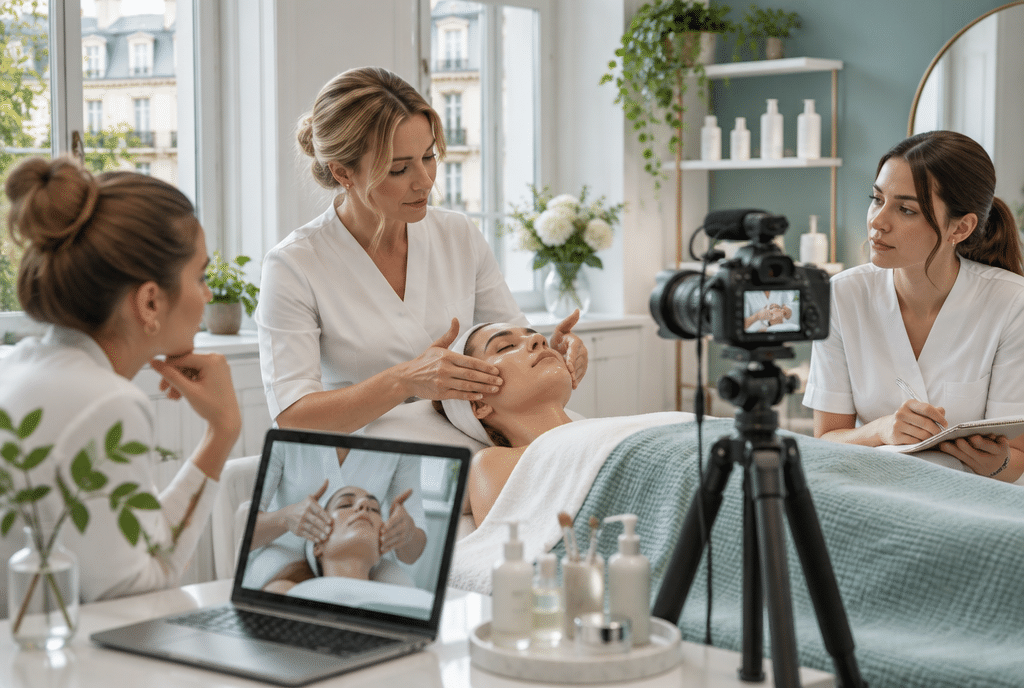
Biomimetic peptides are short chains of amino acids designed to mimic fragments of the proteins the skin uses every day: procollagen, signalling proteins, copper-carrying complexes. In ingredient lists they look serious, and in manufacturers’ materials they sound more serious still. Below we set out what is known about them from studies, where the data end and how to build an offer around them that will stand up to a client’s questions.
Biomimetic peptides: four groups by mechanism
The division by which biomimetic peptides are classified in scientific reviews, including the paper by Gorouhi and Maibach from 2009, is based on what the peptide is supposed to do in the skin.
- Signal peptides: are meant to stimulate fibroblasts to produce matrix components. The best described example is Palmitoyl Pentapeptide-4, or Pal-KTTKS, known under the trade name Matrixyl. The KTTKS sequence comes from type I procollagen.
- Carrier peptides: deliver the metal ions that enzymes need. The model example is GHK-Cu, a tripeptide in a complex with copper, described in more detail in the article on the copper peptide that declines with age.
- Neurotransmitter-inhibiting peptides: Acetyl Hexapeptide-8, sold as Argireline, reproduces a fragment of the SNAP-25 protein and disrupts the formation of the SNARE complex, on which the release of neurotransmitter from nerve endings depends.
- Enzyme-inhibiting peptides: limit the activity of enzymes that break down skin components, for example metalloproteinases. This group consists mainly of peptide fractions of plant origin, including from soya and rice.
The boundaries between the groups are conventional. GHK-Cu carries copper and at the same time, in laboratory studies, affects the synthesis of collagen and glycosaminoglycans, as gathered in the 2015 review by Pickart and colleagues.
Molecular weight and the 500 dalton rule
In 2000 Bos and Meinardi formulated the 500 dalton rule in Experimental Dermatology: for a compound to pass through the stratum corneum, its molecular weight should be below 500 Da. They argued that practically all common contact allergens and substances used in topical medicines fall below this limit. It is a rule of thumb, derived from observation, but it explains well why peptides in cosmetics differ so much in potential.
GHK has a weight of about 340 Da, so it fits the rule. Pal-KTTKS weighs about 800 Da, Acetyl Hexapeptide-8 close to 890 Da. That is why manufacturers attach a palmitic acid residue to the sequence, which increases the lipophilicity of the molecule, and work on carriers that improve penetration. A review of these methods was published by Ledwoń and colleagues in 2021.
The amino acid sequence says what a peptide can do in cell culture. Molecular weight and formula decide how much of that the client will see.
What the studies say about peptides in cosmetics
Robinson and colleagues in 2005 studied 93 women aged 35 to 55. For 12 weeks they applied a moisturiser with 3 ppm Pal-KTTKS to one half of the face and the same moisturiser without the peptide to the other. The study was double-blind, and image analysis showed a significant improvement in wrinkles and fine lines on the peptide side. The authors were employees of Procter & Gamble.
Blanes-Mira and colleagues in 2002 described Argireline: an emulsion with 10% of the hexapeptide reduced wrinkle depth in healthy female volunteers by up to 30% after 30 days. A later randomised study from 2013 covered 60 people using the product twice a day around the eyes for four weeks; in the subjective assessment, improvement was recorded in 48.9% of people in the peptide group and in no one in the placebo group.
The studies on which biomimetic peptides rest have a common denominator: small groups, short follow-up, measurements of skin surface parameters and frequent involvement of raw material manufacturers. The results are real, but they concern specific formulas and concentrations.
The scale of results: how to talk about it honestly
In the paper on Argireline the authors themselves noted that the peptide inhibited neurotransmitter release with a potency close to that of botulinum toxin type A in a laboratory model, but with much lower efficacy. The results peptides in cosmetics give are measured in percentages of wrinkle depth on silicone replicas, and are often recorded first by the equipment and only later by the eye.
Botulinum toxin is a medicinal product administered by a doctor and belongs to a different category from a cosmetic. Placing the two side by side in an offer inflates the client’s expectations and undermines the salon’s credibility at the first check in the mirror. An honest description reads: biomimetic peptides can gradually smooth fine lines with regular use.
How to read the INCI of peptide products
- INCI name: Matrixyl and Argireline are the trade names of raw materials under which manufacturers sell biomimetic peptides. In the ingredient list look for Palmitoyl Pentapeptide-4, Acetyl Hexapeptide-8 or Copper Tripeptide-1.
- Position in the list: under Article 19 of Regulation (EC) No 1223/2009, ingredients are listed in descending order of weight, and those below 1% in any order. A peptide used at ppm level usually stands near the end of the list.
- Concentration: the label does not state it. Ask the distributor about the amount of raw material and about studies of the finished product.
- Surroundings in the formula: pH and the proximity of acids matter especially for copper peptides, which we discuss in the article on what to combine GHK-Cu with in cosmetics.
How to build biomimetic peptides into the salon’s offer
- Treatment protocol: a peptide serum or mask after cleansing and exfoliation, with a contact time longer than quick massaging in. Plan a series and describe it in the salon’s treatment menu as a skincare treatment.
- Introducing the product with needles: the product must be intended by the manufacturer for such application. An ordinary serum is not suitable for this.
- Home care: the studies that tested peptides in cosmetics lasted 4 to 12 weeks of daily use, so the result is built at home. We describe choosing products for retail in the article on retail sales in the beauty salon.
- Communication: use wording such as “smooths the appearance of fine lines” and “supports skin condition”. The words “treats”, “rebuilds collagen” or “works like Botox” go beyond the definition of a cosmetic, and claims must meet the criteria of Regulation (EU) No 655/2013, including honesty and evidential support.
Biomimetic peptides work best in a package combining both elements: a series of treatments in the salon and a product for home use over the same period. The client gets a coherent plan, and you get a reason for a follow-up visit after six weeks.
Biomimetic peptides in a treatment step by step
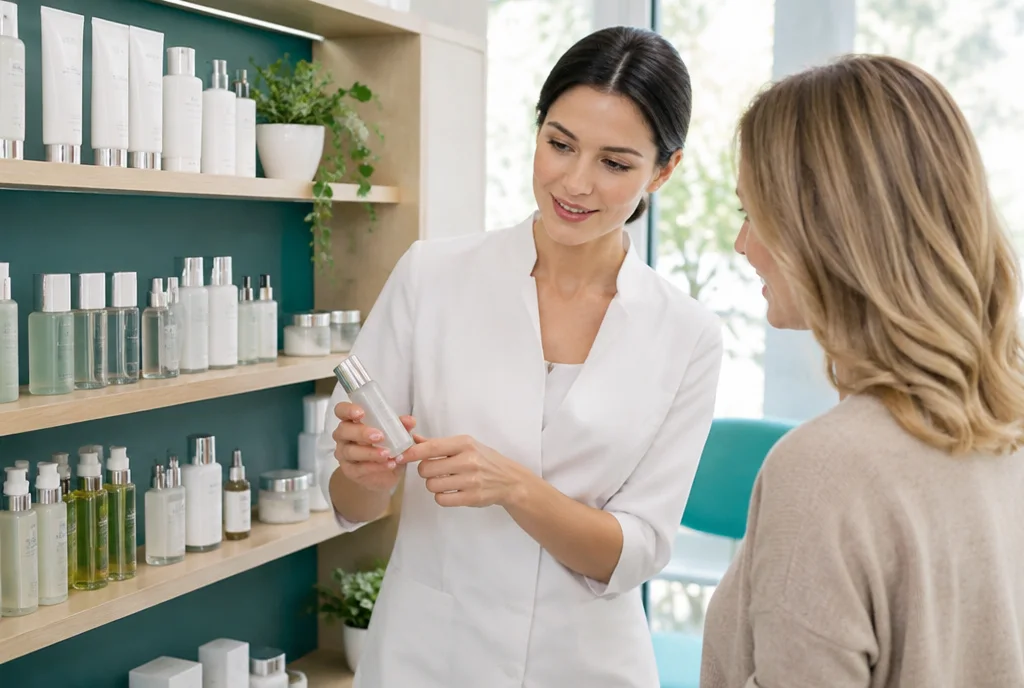
In the salon, biomimetic peptides need above all contact time and a well-prepared skin surface. The scheme below describes a skincare treatment lasting 60 to 75 minutes, without needle application. You adjust the parameters of each stage to the product data sheet and to the condition of the skin assessed at the start of the visit.
- History and skin assessment: record on the client card her current home care, including retinoids and acids, treatments in the last 4 weeks and known allergies. Assess hydration, firmness, erythema and fine lines around the eyes and on the forehead.
- Make-up removal and cleansing: a cleanser with a pH of 4.5 to 5.5, close to the pH of the skin surface, removes sebum and sunscreen residue without drying out the stratum corneum.
- Exfoliation: a superficial acid or enzyme peel removes loosely bound corneocytes. An enzyme peel contains proteases, such as papain or bromelain, which cut peptide bonds, so rinse it off thoroughly with water before the next stage. After acids, neutralise the skin in line with the manufacturer’s instructions.
- Serum application: apply a peptide serum or ampoule in a thin layer and work it in with massage for 5 to 10 minutes, along the skin’s tension lines, without vigorous rubbing.
- Occlusive mask: an alginate or hydrogel mask applied over the serum limits water evaporation from the epidermis and extends contact time by a further 15 to 20 minutes. A hydrated stratum corneum lets active ingredients through more easily.
- Finish: a cream with emollients and, for daytime, a high-protection sunscreen with confirmed UVA protection. Record the product names and batch numbers on the card.
Offer the client a series of 4 to 6 visits at intervals of 7 to 14 days. This rhythm covers a period of 6 to 12 weeks, the range over which studies assessed peptides in cosmetics. There is one condition: between visits the client uses the product at home every day.
Matching to the skin’s needs
- First fine lines: for clients around thirty, signal peptides in a light serum, used in the morning under sunscreen, are enough. The series in the salon can be shorter, 3 to 4 visits.
- Mature and dry skin: biomimetic peptides from the signal and carrier groups in a cream with ceramides and squalane. With a thin, dried-out stratum corneum, give up the acid peel in favour of an enzyme one.
- Expression lines: products with Acetyl Hexapeptide-8 applied locally around the eyes and on the forehead, as a complement to a serum for the whole face.
- Skin with erythema and prone to redness: fragrance-free formulas, low-pressure massage, a cooling mask, no acid stage.
- Oily and combination skin: a gel-textured serum and a light emulsion cream. Heavy occlusion overnight increases the risk of blackheads in these clients.
What to combine peptides in cosmetics with, and what to separate
Peptides in cosmetics are sensitive to hydrolysis, extreme pH and proteolytic enzymes. Most of them cope well alongside hydrating and soothing ingredients. With strong exfoliating ingredients and with copper peptides, separate the application in time: at different times of day or on the days following a treatment.
| Ingredient | Combination | How to use |
|---|---|---|
| Hyaluronic acid, glycerine, panthenol | Together | In one formula or as the next layer under cream. |
| Niacinamide | Together | A common combination in finished serums, well tolerated by sensitive skin. |
| Ceramides, squalane, phytosterols | Together | A barrier cream applied over the serum completes the routine. |
| Retinol, retinal | Together or separately | In the evening; in the case of irritation, peptides in the morning and the retinoid in the evening. |
| L-ascorbic acid | Separately with GHK-Cu | Vitamin C in the morning, the copper peptide in the evening. |
| AHA and BHA acids at treatment concentrations | Separately | A peel in the salon, a peptide serum after neutralisation or on the following days. |
| Proteolytic enzymes | Separately | Rinse off the enzyme peel before applying the serum. |
With retinoids, the skin’s tolerance decides. A client who is only just introducing retinol will get through the adaptation period more gently if she applies biomimetic peptides in a light serum in the morning and the retinoid in a cream with emollients in the evening. Once the skin tolerates both ingredients, she can use them together in the evening, in one formula or in two successive layers.
In device-based treatments the order follows from the stage of the visit. After a treatment from the salon’s menu based on microdermabrasion, hydrogen cleansing or sonophoresis, the peptide serum comes in at the end, as the skincare stage. After a deeper chemical peel, move peptides to the following days of home care, once erythema and flaking have subsided.
At home the order of layers is set by texture, from a water-based formula to the thickest. The client applies a water-based peptide serum to cleansed, slightly damp skin, before oil and cream. Oil applied under the serum leaves a film on the surface through which hydrophilic molecules pass less well. When a client chooses peptides in cosmetics with a thicker texture, these are usually palmitoylated peptides, which thanks to the fatty acid residue sit well in creams and emulsions.
The home plan and measuring the result in the salon
In the studies described, the result arose with application once or twice a day throughout the observation period. Give the client the home plan in writing, with the product name, the time of day and the order of layers.
- In the morning: gentle cleansing, a peptide serum, moisturiser and broad-spectrum sunscreen. UVA radiation increases the activity of the metalloproteinases that break down collagen, so sunscreen protects what the serum looks after.
- In the evening: two-step make-up removal, a peptide serum or a retinoid as agreed in the salon, a barrier cream.
- Eye area: separate products with Acetyl Hexapeptide-8 are used for expression lines at the corners of the eyes. The client applies them with the pad of the ring finger, locally, on the orbital bone.
- Regularity: missed days lengthen the period after which the result can be assessed. Ask the client to note the days of use in the calendar on her phone.
- Starter product: hand over the product together with the plan at the first visit, so that the client starts using biomimetic peptides on the day of the treatment. We describe the rules for choosing a retail line in the article on retail sales in the salon.
Assess the result in a similar way to the study authors, in a simplified salon version. Take photographs of the face front-on and from both profiles before the first visit, after 6 and after 12 weeks, always in the same light, from the same distance, without make-up and with the face at rest. Photograph the eye area additionally while smiling, because neurotransmitter-inhibiting peptides are meant to act on dynamic wrinkles.
If you have a corneometer in the salon, measure the hydration of the stratum corneum at fixed points, for example on the cheek and the forehead, after the client has acclimatised in the room for a quarter of an hour. Compare measurements taken at a similar temperature and humidity, because both conditions change the result. Enter the results on the client card next to the photographs, and at the follow-up visit show her both series. Photographs in an identical position convince more strongly than a description from a leaflet.
The conversation with the client at the start of the series
At the first visit, tell the client plainly what she can expect and when. After the treatment the skin will be hydrated and smoother to the touch. Fine lines may become shallower gradually, with daily use over 6 to 12 weeks, while deep, static wrinkles will remain beyond the reach of a cosmetic. Describe biomimetic peptides as an ingredient of anti-ageing care with a documented, moderate effect. A client who knows this range from the start comes to the follow-up visit and assesses the photographs calmly.
Mistakes when working with peptides in the salon
- Too short a contact: a serum massaged in within a minute and immediately covered with cream is a waste of the most expensive stage of the treatment. Plan massage and an occlusive mask into the protocol.
- A promise after one visit: after a single treatment the client will see the hydration and smoothing that come from the formula. Describe the anti-wrinkle effect as the result of a series combined with home care.
- Mixing products in a bowl: combining the serum with an acid, vitamin C or an enzyme just before application changes the pH and stability of a formula the manufacturer tested in its original packaging.
- Storage: a serum standing by the treatment lamp or on the windowsill loses stability faster. Keep it at the temperature given in the product data sheet, away from light, and use it within the time given by the open jar symbol (PAO).
- Trade name instead of ingredients: a product advertised as “with Matrixyl” may contain different generations of the raw material, for example Matrixyl 3000, that is Palmitoyl Tripeptide-1 with Palmitoyl Tetrapeptide-7. Check the INCI names and ask about the concentration.
- Too dense a series schedule: visits more often than every 7 days, each time with exfoliation, dry out the stratum corneum and increase the skin’s reactivity. With thin and sensitive skin, run every second visit without the exfoliating stage.
- No sunscreen in the plan: a client who uses biomimetic peptides without daily UVA protection triggers every day the collagen degradation the serum is meant to offset.
Each of these mistakes can be caught at the protocol stage. Write it down once, with the times of the stages and the product names, and share it with the whole team, so that every cosmetologist in the salon runs the treatment the same way.
The most common questions about biomimetic peptides
Can peptides in cosmetics be combined with acids and retinoids?
This depends more on the formula than on the peptide group. Most reservations concern copper peptides in a low-pH environment. With the others, follow the recommendations of the product manufacturer.
After how long will the client see a result?
The studies that assessed biomimetic peptides measured results after 4 to 12 weeks of regular use. A single treatment mainly gives hydration and smoothing from the formula itself.
Does a higher concentration mean a better result?
There are too few data to settle this, because peptides in cosmetics are rarely studied at several concentrations in one protocol. The concentrations in the studies described differ by orders of magnitude, from 3 ppm to 10%, which is why a study of the finished product is the reliable guide.
Are biomimetic peptides suitable for sensitive skin?
Biomimetic peptides are used at low concentrations and are rarely a source of irritation. A skin reaction is more often caused by the surroundings in the formula: fragrance, alcohol high in the ingredient list, a preservative. With reactive skin, choose fragrance-free formulas and do a test on a small area, for example behind the ear, 48 hours before the first treatment.
How long should peptides in cosmetics be used after the series ends?
Peptides in cosmetics work during the period of use, and there are few data on how long the result lasts after stopping. A sensible plan is home care without breaks and a top-up series in the salon every few months, for example in autumn, after the season of strong sun.
For the salon in brief: biomimetic peptides divide into signal, carrier, neurotransmitter-inhibiting and enzyme-inhibiting peptides. Most have a weight above 500 Da, and the studies are small and short, though with results significant against placebo. Build them into your offer as a series of treatments with home care and describe the results in the language of a cosmetic.
Would you like to build a peptide protocol and choose a home retail line to go with it? Book a free consultation and discover ZQ-II Medical Skin Care cosmetics.